


Page 159 - Applied Statistics with R
P. 159
9.1. MATRIX APPROACH TO REGRESSION                                159


                      We can then solve this expression by multiplying both sides by the inverse of
                        ⊤
                           , which exists, provided the columns of    are linearly independent. Then
                      as always, we denote our solution with a hat.

                                                  ̂
                                                       ⊤
                                                               ⊤
                                                   = (     ) −1
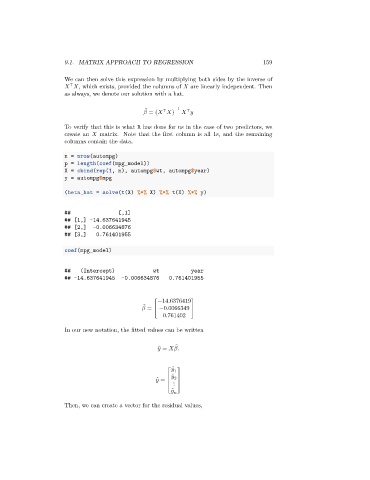
                      To verify that this is what R has done for us in the case of two predictors, we
                      create an    matrix. Note that the first column is all 1s, and the remaining
                      columns contain the data.


                      n = nrow(autompg)
                      p = length(coef(mpg_model))
                      X = cbind(rep(1, n), autompg$wt, autompg$year)
                      y = autompg$mpg

                      (beta_hat = solve(t(X) %*% X) %*% t(X) %*% y)


                      ##                [,1]
                      ## [1,] -14.637641945
                      ## [2,]   -0.006634876
                      ## [3,]    0.761401955

                      coef(mpg_model)


                      ##    (Intercept)             wt          year
                      ## -14.637641945   -0.006634876    0.761401955


                                                     −14.6376419
                                                 ̂
                                                   =  ⎡  −0.0066349  ⎤
                                                                ⎥
                                                    ⎢
                                                    ⎣ 0.761402 ⎦
                      In our new notation, the fitted values can be written

                                                      ̂    =     . ̂


                                                           ̂
                                                           1
                                                        ⎡  ̂     ⎤
                                                      ̂    = ⎢  2 ⎥
                                                        ⎢ ⋮ ⎥
                                                        ⎣ ̂   ⎦

                      Then, we can create a vector for the residual values,

