


Page 158 - Applied Statistics with R
P. 158
158                   CHAPTER 9. MULTIPLE LINEAR REGRESSION


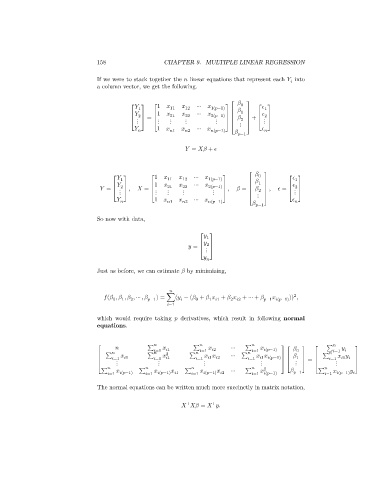
                                 If we were to stack together the    linear equations that represent each    into

                                 a column vector, we get the following.


                                                 1   1     11     12  ⋯     1(  −1) ⎡  0  ⎤     1
                                            ⎡     ⎤  ⎡ 1          ⋯         ⎤ ⎢     1  ⎥  ⎡ ⎤

                                            ⎢  2 ⎥ = ⎢   21   22       2(  −1) ⎥ ⎢     2 ⎥  + ⎢ ⎥
                                                                                         2
                                            ⎢ ⋮ ⎥   ⎢⋮   ⋮    ⋮         ⋮   ⎥ ⎢ ⋮ ⎥   ⎢ ⋮ ⎥
                                            ⎣   ⎦   ⎣ 1       1       2  ⋯       (  −1)⎦ ⎣     −1⎦  ⎣   ⎦


                                                                 =      +


                                           1        1     11     12  ⋯     1(  −1)  ⎡  0  ⎤          1
                                      ⎡     ⎤      ⎡ 1           ⋯         ⎤       ⎢     1  ⎥   ⎡ ⎤

                                                                                                   2
                                     = ⎢  2 ⎥ ,     = ⎢  21  22       2(  −1) ⎥ ,     =      ,     = ⎢ ⎥
                                      ⎢ ⋮ ⎥        ⎢⋮   ⋮    ⋮         ⋮   ⎥       ⎢   2 ⎥      ⎢ ⋮ ⎥
                                                                                   ⎢ ⋮ ⎥
                                      ⎣   ⎦        ⎣ 1      1       2  ⋯      (  −1)⎦  ⎣     −1⎦  ⎣   ⎦


                                 So now with data,
                                                                       1
                                                                   ⎡     ⎤
                                                                  = ⎢  2 ⎥
                                                                   ⎢ ⋮ ⎥
                                                                   ⎣   ⎦

                                 Just as before, we can estimate    by minimizing,


                                                                                                  2

                                     (   ,    ,    , ⋯ ,      −1 ) = ∑(   − (   +       +       + ⋯ +      −1   (  −1) )) ,
                                         1
                                            2
                                                                      1   1
                                      0
                                                                             2   2

                                                                  0
                                                          =1
                                 which would require taking    derivatives, which result in following normal
                                 equations.

                                                  ∑         1    ∑         2  ⋯   ∑         (  −1)           ∑
                                 ⎡                    =1  2            =1               =1    ⎤ ⎡  0  ⎤  ⎡          =1      ⎤

                                 ⎢  ∑   =1       1  ∑   =1       1  ∑   =1         ⋯  ∑   =1         ⎥ ⎢     1  ⎥ = ⎢  ∑   =1         ⎥
                                                                                         1   (  −1)
                                                                        1   2
                                                                                                                    1
                                 ⎢       ⋮           ⋮               ⋮                  ⋮     ⎥ ⎢ ⋮ ⎥    ⎢      ⋮     ⎥


                                 ⎣ ∑   =1       (  −1)  ∑   =1       (  −1)   1  ∑   =1       (  −1)   2  ⋯  ∑   =1     2   (  −1) ⎦ ⎣     −1⎦  ⎣ ∑   =1       (  −1)   ⎦
                                 The normal equations can be written much more succinctly in matrix notation,
                                                               ⊤
                                                                       ⊤
                                                                     =      .

