


Page 218 - Applied Statistics with R
P. 218
218 CHAPTER 11. CATEGORICAL PREDICTORS AND INTERACTIONS


                                    • 6 Cylinder: grey dots, dashed grey line.
                                    • 8 Cylinder: blue dots, dotted blue line.


                                 The odd result here is that we’re estimating that 8 cylinder cars have better
                                 fuel efficiency than 6 cylinder cars at any displacement! The dotted blue line
                                 is always above the dashed grey line. That doesn’t seem right. Maybe for very
                                 large displacement engines that could be true, but that seems wrong for medium
                                 to low displacement.
                                 To attempt to fix this, we will try using an interaction model, that is, instead
                                 of simply three intercepts and one slope, we will allow for three slopes. Again,
                                 we’ll let R take the wheel (no pun intended), then figure out what model it has
                                 applied.

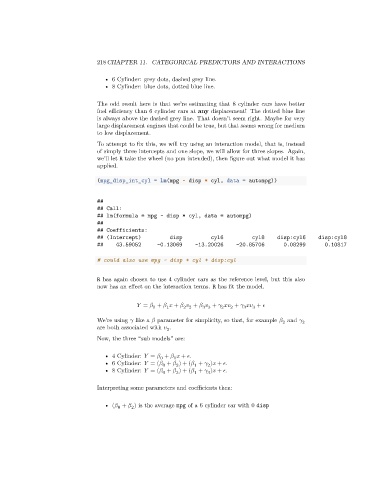
                                 (mpg_disp_int_cyl = lm(mpg ~ disp * cyl, data = autompg))


                                 ##
                                 ## Call:
                                 ## lm(formula = mpg ~ disp * cyl, data = autompg)
                                 ##
                                 ## Coefficients:
                                 ## (Intercept)          disp          cyl6         cyl8     disp:cyl6    disp:cyl8
                                 ##    43.59052      -0.13069     -13.20026    -20.85706       0.08299      0.10817

                                 # could also use mpg ~ disp + cyl + disp:cyl


                                 R has again chosen to use 4 cylinder cars as the reference level, but this also
                                 now has an effect on the interaction terms. R has fit the model.


                                                 =    +       +       +       +         +         +
                                                                                  3
                                                                                     3
                                                                             2
                                                                          2
                                                    0
                                                              2 2
                                                                    3 3
                                                        1
                                 We’re using    like a    parameter for simplicity, so that, for example    and    2
                                                                                              2
                                 are both associated with    .
                                                        2
                                 Now, the three “sub models” are:
                                    • 4 Cylinder:    =    +       +   .
                                                      0
                                                           1
                                    • 6 Cylinder:    = (   +    ) + (   +    )   +   .
                                                                 1
                                                                      2
                                                       0
                                                           2
                                    • 8 Cylinder:    = (   +    ) + (   +    )   +   .
                                                                      3
                                                           3
                                                       0
                                                                 1
                                 Interpreting some parameters and coefficients then:
                                    • (   +    ) is the average mpg of a 6 cylinder car with 0 disp
                                            2
                                        0

