


Page 223 - Applied Statistics with R
P. 223
11.4. PARAMETERIZATION                                            223


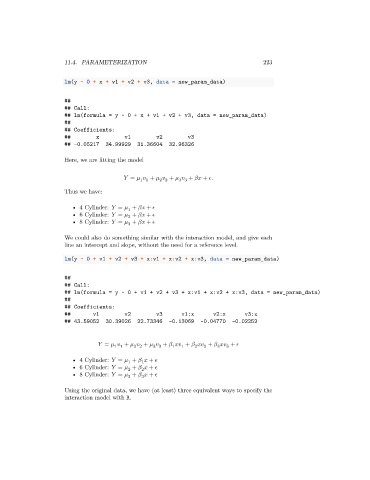
                      lm(y ~ 0 + x + v1 + v2 + v3, data = new_param_data)


                      ##
                      ## Call:
                      ## lm(formula = y ~ 0 + x + v1 + v2 + v3, data = new_param_data)
                      ##
                      ## Coefficients:
                      ##         x        v1         v2        v3
                      ## -0.05217   34.99929  31.36604   32.96326

                      Here, we are fitting the model


                                             =       +       +       +      +   .
                                               1 1
                                                      2 2
                                                            3 3
                      Thus we have:
                         • 4 Cylinder:    =    +      +
                                           1
                         • 6 Cylinder:    =    +      +
                                           2
                         • 8 Cylinder:    =    +      +
                                           3
                      We could also do something similar with the interaction model, and give each
                      line an intercept and slope, without the need for a reference level.

                      lm(y ~ 0 + v1 + v2 + v3 + x:v1 + x:v2 + x:v3, data = new_param_data)


                      ##
                      ## Call:
                      ## lm(formula = y ~ 0 + v1 + v2 + v3 + x:v1 + x:v2 + x:v3, data = new_param_data)
                      ##
                      ## Coefficients:
                      ##        v1        v2         v3      v1:x       v2:x      v3:x
                      ## 43.59052   30.39026  22.73346   -0.13069  -0.04770   -0.02252


                                    =       +       +       +         +         +         +
                                                    3 3
                                             2 2
                                                          1
                                                             1
                                                                         3
                                                                            3
                                                                    2
                                       1 1
                                                                 2
                         • 4 Cylinder:    =    +       +
                                                1
                                           1
                         • 6 Cylinder:    =    +       +
                                           2
                                                2
                         • 8 Cylinder:    =    +       +
                                                3
                                           3
                      Using the original data, we have (at least) three equivalent ways to specify the
                      interaction model with R.

