


Page 226 - Applied Statistics with R
P. 226
226 CHAPTER 11. CATEGORICAL PREDICTORS AND INTERACTIONS


                                 If the two and three way interactions were not in the model, the whole “coeffi-
                                 cient” would simply be


                                                                     .
                                                                   1
                                 Thus, no matter the values of    and    ,    would determine the relationship
                                                             2
                                                                       1
                                                                    3
                                 between    (disp) and    (mpg).
                                          1
                                 With the addition of the two-way interactions, now the “coefficient” would be
                                                           (   +       +       ).
                                                             1
                                                                 4 2
                                                                        5 3
                                 Now, changing    (disp) has a different effect on    (mpg), depending on the
                                                1
                                 values of    and    .
                                                 3
                                          2
                                 Lastly, adding the three-way interaction gives the whole “coefficient”
                                                       (   +       +       +          )
                                                                          7 2 3
                                                                    5 3
                                                             4 2
                                                         1
                                 which is even more flexible. Now changing    (disp) has a different effect on
                                                                        1
                                 (mpg), depending on the values of    and    , but in a more flexible way which
                                                                       3
                                                                2
                                 we can see with some more rearrangement. Now the “coefficient” in front of    3
                                 in this “coefficient” is dependent on    .
                                                                  2
                                                       (   +       + (   +       )   )
                                                                         7 2
                                                              4 2
                                                                     5
                                                                              3
                                                         1
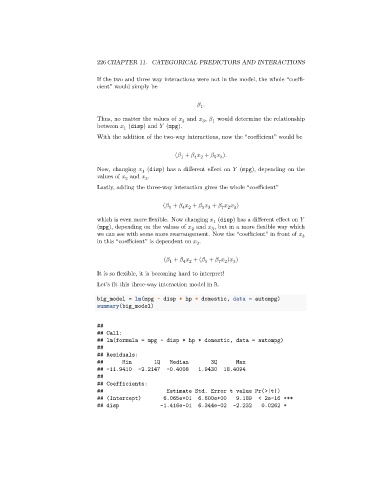
                                 It is so flexible, it is becoming hard to interpret!
                                 Let’s fit this three-way interaction model in R.
                                 big_model = lm(mpg ~ disp * hp * domestic, data = autompg)
                                 summary(big_model)

                                 ##
                                 ## Call:
                                 ## lm(formula = mpg ~ disp * hp * domestic, data = autompg)
                                 ##
                                 ## Residuals:
                                 ##       Min       1Q   Median        3Q      Max
                                 ## -11.9410   -2.2147  -0.4008    1.9430  18.4094
                                 ##
                                 ## Coefficients:
                                 ##                     Estimate Std. Error t value Pr(>|t|)
                                 ## (Intercept)        6.065e+01   6.600e+00   9.189  < 2e-16 ***
                                 ## disp              -1.416e-01   6.344e-02  -2.232    0.0262 *

