


Page 224 - Applied Statistics with R
P. 224
224 CHAPTER 11. CATEGORICAL PREDICTORS AND INTERACTIONS


                                 lm(mpg ~ disp * cyl, data = autompg)


                                 ##
                                 ## Call:
                                 ## lm(formula = mpg ~ disp * cyl, data = autompg)
                                 ##
                                 ## Coefficients:
                                 ## (Intercept)          disp          cyl6         cyl8     disp:cyl6    disp:cyl8
                                 ##    43.59052      -0.13069     -13.20026    -20.85706       0.08299      0.10817

                                 lm(mpg ~ 0 + cyl + disp : cyl, data = autompg)


                                 ##
                                 ## Call:
                                 ## lm(formula = mpg ~ 0 + cyl + disp:cyl, data = autompg)
                                 ##
                                 ## Coefficients:
                                 ##       cyl4       cyl6        cyl8  cyl4:disp  cyl6:disp   cyl8:disp
                                 ##  43.59052    30.39026   22.73346    -0.13069   -0.04770    -0.02252

                                 lm(mpg ~ 0 + disp + cyl + disp : cyl, data = autompg)


                                 ##
                                 ## Call:
                                 ## lm(formula = mpg ~ 0 + disp + cyl + disp:cyl, data = autompg)
                                 ##
                                 ## Coefficients:
                                 ##       disp       cyl4        cyl6       cyl8  disp:cyl6   disp:cyl8
                                 ##  -0.13069    43.59052   30.39026    22.73346    0.08299     0.10817


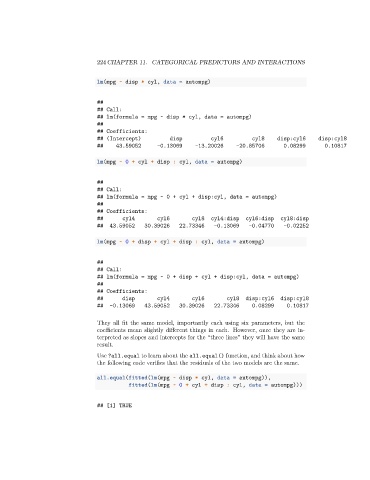
                                 They all fit the same model, importantly each using six parameters, but the
                                 coefficients mean slightly different things in each. However, once they are in-
                                 terpreted as slopes and intercepts for the “three lines” they will have the same
                                 result.

                                 Use ?all.equal to learn about the all.equal() function, and think about how
                                 the following code verifies that the residuals of the two models are the same.

                                 all.equal(fitted(lm(mpg ~ disp * cyl, data = autompg)),
                                            fitted(lm(mpg ~ 0 + cyl + disp : cyl, data = autompg)))


                                 ## [1] TRUE

