


Page 256 - Applied Statistics with R
P. 256
256                          CHAPTER 12. ANALYSIS OF VARIANCE


                                 The row for Factor B tests:


                                                   ∶ All    = 0.  vs    ∶ Not all    are 0.
                                                  0
                                                                      1


                                    • Null Model:            =    +    +           . (Only Factor A Model.)

                                    • Alternative Model:            =    +    +    +           . (Additive Model.)


                                 We reject the null when the    statistic is large. Under the null hypothesis,
                                 the distribution of the test statistic is    with degrees of freedom    − 1 and
                                     (   − 1).
                                 The row for Factor A tests:


                                                   ∶ All    = 0.  vs    ∶ Not all    are 0.


                                                  0
                                                                      1
                                    • Null Model:            =    +    +           . (Only Factor B Model.)

                                    • Alternative Model:            =    +    +    +           . (Additive Model.)


                                 We reject the null when the    statistic is large. Under the null hypothesis, the
                                 distribution of the test statistic is    with degrees of freedom   −1 and     (  −1).
                                 These tests should be performed according to the model hierarchy. First con-
                                 sider the test of interaction. If it is significant, we select the interaction model
                                 and perform no further testing. If interaction is not significant, we then consider
                                 the necessity of the individual factors of the additive model.

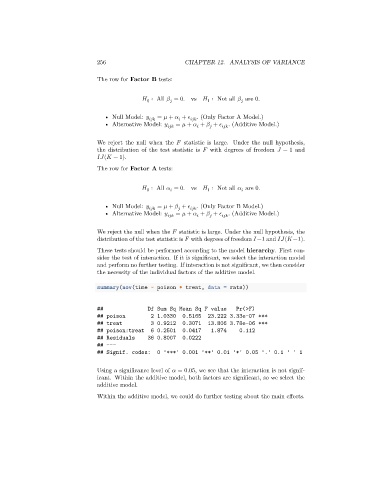
                                 summary(aov(time ~ poison * treat, data = rats))


                                 ##               Df Sum Sq Mean Sq F value    Pr(>F)
                                 ## poison         2 1.0330  0.5165   23.222 3.33e-07 ***
                                 ## treat          3 0.9212  0.3071   13.806 3.78e-06 ***
                                 ## poison:treat   6 0.2501  0.0417    1.874    0.112
                                 ## Residuals     36 0.8007  0.0222
                                 ## ---
                                 ## Signif. codes:   0 '***' 0.001 '**' 0.01 '*' 0.05 '.' 0.1 ' ' 1


                                 Using a significance level of    = 0.05, we see that the interaction is not signif-
                                 icant. Within the additive model, both factors are significant, so we select the
                                 additive model.
                                 Within the additive model, we could do further testing about the main effects.

