


Page 254 - Applied Statistics with R
P. 254
254                          CHAPTER 12. ANALYSIS OF VARIANCE


                                 knitr::kable(get_est_means(model = rats_int, table = rats_table))


                                           I      II    III
                                  A   0.4125  0.3200  0.210
                                  B   0.8800  0.8150  0.335
                                  C   0.5675  0.3750  0.235
                                  D   0.6100  0.6675  0.325

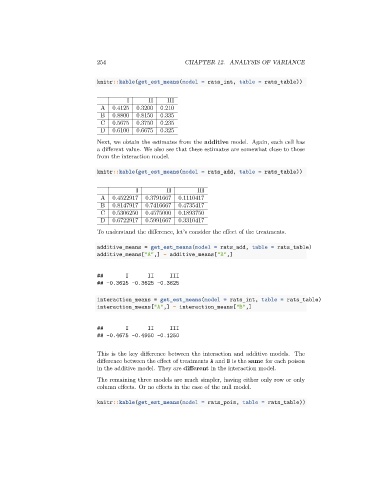
                                 Next, we obtain the estimates from the additive model. Again, each cell has
                                 a different value. We also see that these estimates are somewhat close to those
                                 from the interaction model.

                                 knitr::kable(get_est_means(model = rats_add, table = rats_table))


                                              I         II        III
                                  A   0.4522917  0.3791667  0.1110417
                                  B   0.8147917  0.7416667  0.4735417
                                  C   0.5306250  0.4575000  0.1893750
                                  D   0.6722917  0.5991667  0.3310417
                                 To understand the difference, let’s consider the effect of the treatments.

                                 additive_means = get_est_means(model = rats_add, table = rats_table)
                                 additive_means["A",] - additive_means["B",]


                                 ##        I      II     III
                                 ## -0.3625 -0.3625 -0.3625

                                 interaction_means = get_est_means(model = rats_int, table = rats_table)
                                 interaction_means["A",] - interaction_means["B",]


                                 ##        I      II     III
                                 ## -0.4675 -0.4950 -0.1250

                                 This is the key difference between the interaction and additive models. The
                                 difference between the effect of treatments A and B is the same for each poison
                                 in the additive model. They are different in the interaction model.

                                 The remaining three models are much simpler, having either only row or only
                                 column effects. Or no effects in the case of the null model.

                                 knitr::kable(get_est_means(model = rats_pois, table = rats_table))

