


Page 253 - Applied Statistics with R
P. 253
12.5. TWO-WAY ANOVA                                               253


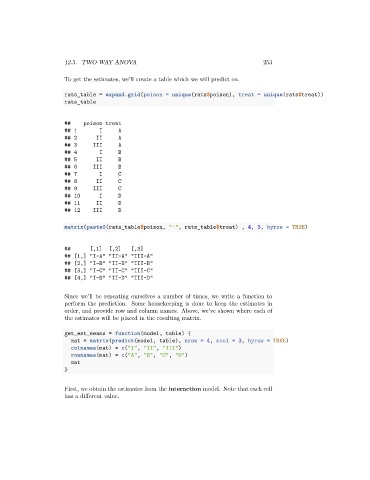
                      To get the estimates, we’ll create a table which we will predict on.

                      rats_table = expand.grid(poison = unique(rats$poison), treat = unique(rats$treat))
                      rats_table


                      ##     poison treat
                      ## 1        I     A
                      ## 2       II     A
                      ## 3      III     A
                      ## 4        I     B
                      ## 5       II     B
                      ## 6      III     B
                      ## 7        I     C
                      ## 8       II     C
                      ## 9      III     C
                      ## 10       I     D
                      ## 11      II     D
                      ## 12     III     D

                      matrix(paste0(rats_table$poison, "-", rats_table$treat) , 4, 3, byrow = TRUE)


                      ##       [,1]  [,2]   [,3]
                      ## [1,] "I-A" "II-A" "III-A"
                      ## [2,] "I-B" "II-B" "III-B"
                      ## [3,] "I-C" "II-C" "III-C"
                      ## [4,] "I-D" "II-D" "III-D"

                      Since we’ll be repeating ourselves a number of times, we write a function to
                      perform the prediction. Some housekeeping is done to keep the estimates in
                      order, and provide row and column names. Above, we’ve shown where each of
                      the estimates will be placed in the resulting matrix.

                      get_est_means = function(model, table) {
                        mat = matrix(predict(model, table), nrow = 4, ncol = 3, byrow = TRUE)
                        colnames(mat) = c("I", "II", "III")
                        rownames(mat) = c("A", "B", "C", "D")
                        mat
                      }


                      First, we obtain the estimates from the interaction model. Note that each cell
                      has a different value.

