


Page 252 - Applied Statistics with R
P. 252
252                          CHAPTER 12. ANALYSIS OF VARIANCE


                                 levels(rats$treat)


                                 ## [1] "A" "B" "C" "D"

                                 Here, 48 rats were randomly assigned both one of three poisons and one of four
                                 possible treatments. The experimenters then measures their survival time in
                                 tens of hours. A total of 12 groups, each with 4 replicates.
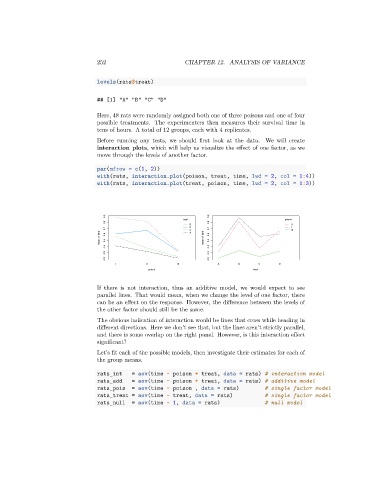
                                 Before running any tests, we should first look at the data. We will create
                                 interaction plots, which will help us visualize the effect of one factor, as we
                                 move through the levels of another factor.

                                 par(mfrow = c(1, 2))
                                 with(rats, interaction.plot(poison, treat, time, lwd = 2, col = 1:4))
                                 with(rats, interaction.plot(treat, poison, time, lwd = 2, col = 1:3))


                                    0.9                               0.9
                                                                treat                             poison
                                    0.8                               0.8
                                                                B                                II
                                    0.7                         D C A  0.7                       I III
                                  mean of  time  0.6  0.5           mean of  time  0.6  0.5
                                    0.4                               0.4
                                    0.3                               0.3
                                    0.2                               0.2
                                       I         II         III          A      B      C     D
                                                  poison                             treat


                                 If there is not interaction, thus an additive model, we would expect to see
                                 parallel lines. That would mean, when we change the level of one factor, there
                                 can be an effect on the response. However, the difference between the levels of
                                 the other factor should still be the same.
                                 The obvious indication of interaction would be lines that cross while heading in
                                 different directions. Here we don’t see that, but the lines aren’t strictly parallel,
                                 and there is some overlap on the right panel. However, is this interaction effect
                                 significant?
                                 Let’s fit each of the possible models, then investigate their estimates for each of
                                 the group means.
                                 rats_int    = aov(time ~ poison * treat, data = rats) # interaction model
                                 rats_add    = aov(time ~ poison + treat, data = rats) # additive model
                                 rats_pois   = aov(time ~ poison , data = rats)          # single factor model
                                 rats_treat = aov(time ~ treat, data = rats)             # single factor model
                                 rats_null   = aov(time ~ 1, data = rats)                # null model

