


Page 255 - Applied Statistics with R
P. 255
12.5. TWO-WAY ANOVA                                               255


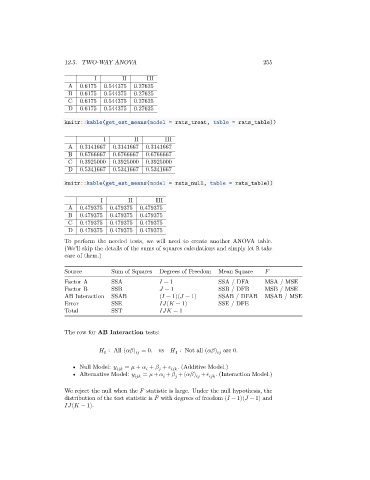
                                I        II       III
                        A  0.6175  0.544375  0.27625
                        B  0.6175  0.544375  0.27625
                        C  0.6175  0.544375  0.27625
                        D  0.6175  0.544375  0.27625

                      knitr::kable(get_est_means(model = rats_treat, table = rats_table))

                                   I         II         III
                        A  0.3141667  0.3141667  0.3141667
                        B  0.6766667  0.6766667  0.6766667
                        C  0.3925000  0.3925000  0.3925000
                        D  0.5341667  0.5341667  0.5341667

                      knitr::kable(get_est_means(model = rats_null, table = rats_table))


                                  I        II        III
                        A  0.479375  0.479375  0.479375
                        B  0.479375  0.479375  0.479375
                        C  0.479375  0.479375  0.479375
                        D  0.479375  0.479375  0.479375
                      To perform the needed tests, we will need to create another ANOVA table.
                      (We’ll skip the details of the sums of squares calculations and simply let R take
                      care of them.)

                      Source          Sum of Squares  Degrees of Freedom  Mean Square

                      Factor A        SSA                − 1             SSA / DFA       MSA / MSE
                      Factor B        SSB                − 1             SSB / DFB       MSB / MSE
                      AB Interaction  SSAB            (   − 1)(   − 1)   SSAB / DFAB     MSAB / MSE
                      Error           SSE                 (   − 1)       SSE / DFE
                      Total           SST                    − 1


                      The row for AB Interaction tests:


                                     ∶ All (    ) = 0.  vs    ∶ Not all (    ) are 0.

                                   0

                                                           1
                         • Null Model:            =    +    +    +           . (Additive Model.)


                         • Alternative Model:            =   +    +   +(    ) +          . (Interaction Model.)


                      We reject the null when the    statistic is large. Under the null hypothesis, the
                      distribution of the test statistic is    with degrees of freedom (   − 1)(   − 1) and
                          (   − 1).

