


Page 262 - Applied Statistics with R
P. 262
262                             CHAPTER 13. MODEL DIAGNOSTICS


                                                                   ̂
                                                               E[  ] =   ,

                                 and variance


                                                               ̂
                                                                       ⊤
                                                                   2
                                                          Var[  ] =    (     ) −1  .
                                                                        ̂
                                 In particular, an individual parameter, say    had a normal distribution

                                                             ̂
                                                                       2
                                                              ∼    (   ,       )


                                 where    was the matrix defined as
                                                                       −1
                                                                    ⊤
                                                                = (     )  .
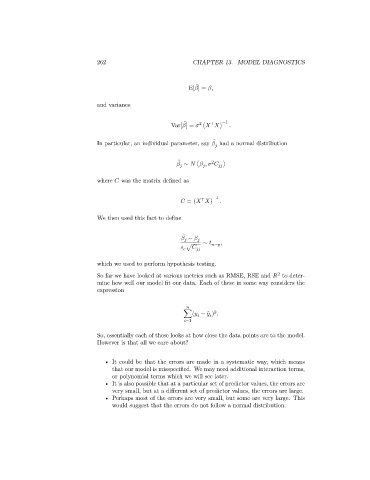
                                 We then used this fact to define


                                                              ̂
                                                                −

                                                                √         ∼      −   ,

                                 which we used to perform hypothesis testing.
                                                                                             2
                                 So far we have looked at various metrics such as RMSE, RSE and    to deter-
                                 mine how well our model fit our data. Each of these in some way considers the
                                 expression


                                                                        2
                                                              ∑(   − ̂ ) .


                                                                =1
                                 So, essentially each of these looks at how close the data points are to the model.
                                 However is that all we care about?

                                    • It could be that the errors are made in a systematic way, which means
                                      that our model is misspecified. We may need additional interaction terms,
                                      or polynomial terms which we will see later.
                                    • It is also possible that at a particular set of predictor values, the errors are
                                      very small, but at a different set of predictor values, the errors are large.
                                    • Perhaps most of the errors are very small, but some are very large. This
                                      would suggest that the errors do not follow a normal distribution.

