


Page 264 - Applied Statistics with R
P. 264
264                             CHAPTER 13. MODEL DIAGNOSTICS


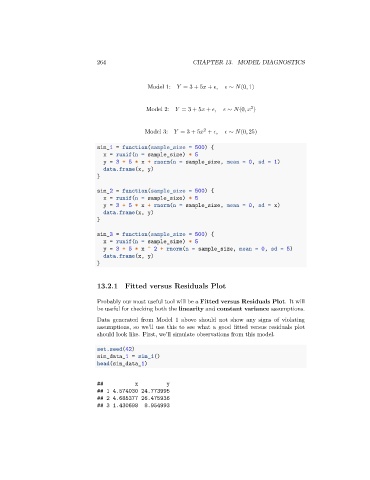
                                                  Model 1:     = 3 + 5   +   ,     ∼   (0, 1)


                                                                                    2
                                                 Model 2:    = 3 + 5   +   ,     ∼   (0,    )

                                                                    2
                                                 Model 3:    = 3 + 5   +   ,     ∼   (0, 25)

                                 sim_1 = function(sample_size = 500) {
                                   x = runif(n = sample_size) * 5
                                   y = 3 + 5 * x + rnorm(n = sample_size, mean = 0, sd = 1)
                                   data.frame(x, y)
                                 }

                                 sim_2 = function(sample_size = 500) {
                                   x = runif(n = sample_size) * 5
                                   y = 3 + 5 * x + rnorm(n = sample_size, mean = 0, sd = x)
                                   data.frame(x, y)
                                 }

                                 sim_3 = function(sample_size = 500) {
                                   x = runif(n = sample_size) * 5
                                   y = 3 + 5 * x ^ 2 + rnorm(n = sample_size, mean = 0, sd = 5)
                                   data.frame(x, y)
                                 }


                                 13.2.1   Fitted versus Residuals Plot


                                 Probably our most useful tool will be a Fitted versus Residuals Plot. It will
                                 be useful for checking both the linearity and constant variance assumptions.
                                 Data generated from Model 1 above should not show any signs of violating
                                 assumptions, so we’ll use this to see what a good fitted versus residuals plot
                                 should look like. First, we’ll simulate observations from this model.

                                 set.seed(42)
                                 sim_data_1 = sim_1()
                                 head(sim_data_1)


                                 ##           x         y
                                 ## 1 4.574030 24.773995
                                 ## 2 4.685377 26.475936
                                 ## 3 1.430698   8.954993

