


Page 338 - Applied Statistics with R
P. 338
338                              CHAPTER 14. TRANSFORMATIONS


                                 ##
                                 ## Model 1: mpg ~ mph + I(mph^2) + I(mph^3) + I(mph^4) + I(mph^5) + I(mph^6)
                                 ## Model 2: mpg ~ mph + I(mph^2) + I(mph^3) + I(mph^4) + I(mph^5) + I(mph^6) +
                                 ##     I(mph^7) + I(mph^8)
                                 ##   Res.Df     RSS Df Sum of Sq       F Pr(>F)
                                 ## 1      21 15.739
                                 ## 2      19 15.506  2    0.2324 0.1424 0.8682

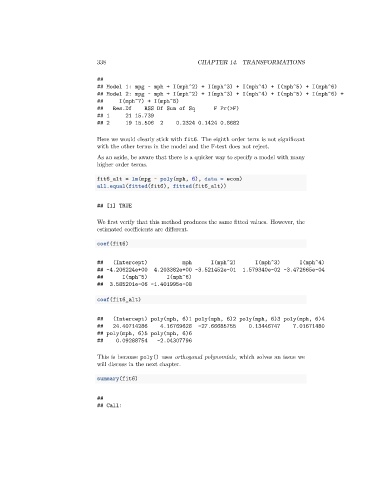
                                 Here we would clearly stick with fit6. The eighth order term is not significant
                                 with the other terms in the model and the F-test does not reject.
                                 As an aside, be aware that there is a quicker way to specify a model with many
                                 higher order terms.

                                 fit6_alt = lm(mpg ~ poly(mph, 6), data = econ)
                                 all.equal(fitted(fit6), fitted(fit6_alt))


                                 ## [1] TRUE

                                 We first verify that this method produces the same fitted values. However, the
                                 estimated coefficients are different.

                                 coef(fit6)


                                 ##   (Intercept)            mph       I(mph^2)      I(mph^3)       I(mph^4)
                                 ## -4.206224e+00   4.203382e+00 -3.521452e-01   1.579340e-02 -3.472665e-04
                                 ##       I(mph^5)      I(mph^6)
                                 ##  3.585201e-06 -1.401995e-08

                                 coef(fit6_alt)


                                 ##   (Intercept) poly(mph, 6)1 poly(mph, 6)2 poly(mph, 6)3 poly(mph, 6)4
                                 ##   24.40714286     4.16769628   -27.66685755    0.13446747     7.01671480
                                 ## poly(mph, 6)5 poly(mph, 6)6
                                 ##    0.09288754    -2.04307796

                                 This is because poly() uses orthogonal polynomials, which solves an issue we
                                 will discuss in the next chapter.


                                 summary(fit6)


                                 ##
                                 ## Call:

