


Page 333 - Applied Statistics with R
P. 333
14.2. PREDICTOR TRANSFORMATION                                    333


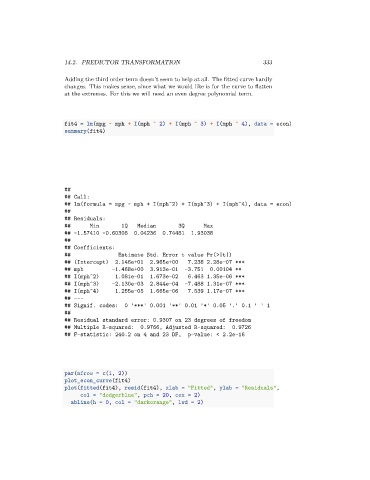
                      Adding the third order term doesn’t seem to help at all. The fitted curve hardly
                      changes. This makes sense, since what we would like is for the curve to flatten
                      at the extremes. For this we will need an even degree polynomial term.


                      fit4 = lm(mpg ~ mph + I(mph ^ 2) + I(mph ^ 3) + I(mph ^ 4), data = econ)
                      summary(fit4)


                      ##
                      ## Call:
                      ## lm(formula = mpg ~ mph + I(mph^2) + I(mph^3) + I(mph^4), data = econ)
                      ##
                      ## Residuals:
                      ##       Min       1Q   Median        3Q      Max
                      ## -1.57410 -0.60308   0.04236   0.74481  1.93038
                      ##
                      ## Coefficients:
                      ##                Estimate Std. Error t value Pr(>|t|)
                      ## (Intercept)   2.146e+01   2.965e+00   7.238 2.28e-07 ***
                      ## mph          -1.468e+00   3.913e-01  -3.751  0.00104 **
                      ## I(mph^2)      1.081e-01   1.673e-02   6.463 1.35e-06 ***
                      ## I(mph^3)     -2.130e-03   2.844e-04  -7.488 1.31e-07 ***
                      ## I(mph^4)      1.255e-05   1.665e-06   7.539 1.17e-07 ***
                      ## ---
                      ## Signif. codes:   0 '***' 0.001 '**' 0.01 '*' 0.05 '.' 0.1 ' ' 1
                      ##
                      ## Residual standard error: 0.9307 on 23 degrees of freedom
                      ## Multiple R-squared:   0.9766, Adjusted R-squared:    0.9726
                      ## F-statistic: 240.2 on 4 and 23 DF,    p-value: < 2.2e-16


                      par(mfrow = c(1, 2))
                      plot_econ_curve(fit4)
                      plot(fitted(fit4), resid(fit4), xlab = "Fitted", ylab = "Residuals",
                            col = "dodgerblue", pch = 20, cex = 2)
                        abline(h = 0, col = "darkorange", lwd = 2)

