


Page 425 - Applied Statistics with R
P. 425
17.2. BINARY RESPONSE                                             425


                      That is, type = "link" will get you the log odds, while type = "response"
                      will return the estimated mean, in this case,   [   = 1 ∣ X = x] for each
                      observation.

                      plot(y ~ x, data = example_data,
                            pch = 20, ylab = "Estimated Probability",
                            main = "Ordinary vs Logistic Regression")
                      grid()
                      abline(fit_lm, col = "darkorange")
                      curve(predict(fit_glm, data.frame(x), type = "response"),
                             add = TRUE, col = "dodgerblue", lty = 2)
                      legend("topleft", c("Ordinary", "Logistic", "Data"), lty = c(1, 2, 0),
                              pch = c(NA, NA, 20), lwd = 2, col = c("darkorange", "dodgerblue", "black"))


                                           Ordinary vs Logistic Regression

                             1.0    Ordinary

                                    Logistic
                             0.8
                                    Data
                        Estimated Probability  0.6  0.4


                             0.0  0.2
                                   -2            -1            0            1

                                                          x


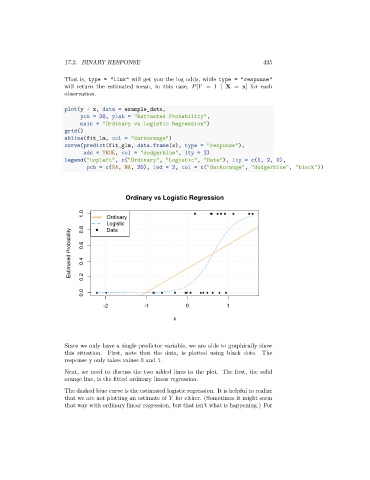
                      Since we only have a single predictor variable, we are able to graphically show
                      this situation. First, note that the data, is plotted using black dots. The
                      response y only takes values 0 and 1.
                      Next, we need to discuss the two added lines to the plot. The first, the solid
                      orange line, is the fitted ordinary linear regression.
                      The dashed blue curve is the estimated logistic regression. It is helpful to realize
                      that we are not plotting an estimate of    for either. (Sometimes it might seem
                      that way with ordinary linear regression, but that isn’t what is happening.) For

