


Page 98 - Applied Statistics with R
P. 98
98                       CHAPTER 7. SIMPLE LINEAR REGRESSION


                                                                +    ∑    = ∑
                                                                 1
                                                             0

                                                                     =1     =1

                                                                       2
                                                         ∑    +    ∑    = ∑


                                                                 1

                                                       0
                                                           =1        =1     =1
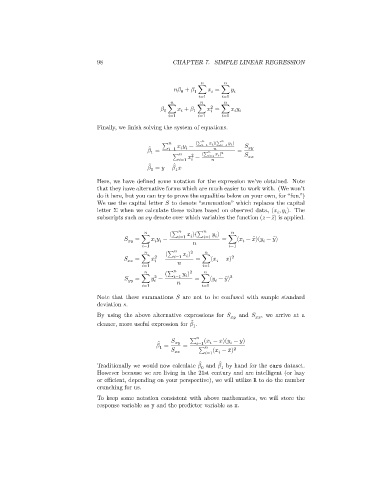
                                 Finally, we finish solving the system of equations.

                                                                  (∑        )(∑        )
                                                       ∑          −    =1    =1

                                                   ̂
                                                     =     =1                 2  =
                                                   1
                                                                2
                                                          ∑        −  (∑   =1        )
                                                              =1
                                                           ̂
                                                   ̂

                                                     = ̄ −       ̄
                                                           1
                                                   0
                                 Here, we have defined some notation for the expression we’ve obtained. Note
                                 that they have alternative forms which are much easier to work with. (We won’t
                                 do it here, but you can try to prove the equalities below on your own, for “fun.”)
                                 We use the capital letter    to denote “summation” which replaces the capital
                                 letter Σ when we calculate these values based on observed data, (   ,    ). The


                                 subscripts such as      denote over which variables the function (  − ̄) is applied.
                                                         (∑        )(∑        )
                                                   = ∑       −    =1        =1      = ∑(   − ̄  )(   − ̄  )


                                                  =1                           =1
                                                        (∑        ) 2
                                                    2
                                                   = ∑    −    =1      = ∑(   − ̄  ) 2


                                                  =1                  =1
                                                        (∑        ) 2
                                                    2
                                                   = ∑    −    =1      = ∑(   − ̄) 2


                                                  =1                  =1
                                 Note that these summations    are not to be confused with sample standard
                                 deviation   .
                                 By using the above alternative expressions for          and    , we arrive at a

                                                                 ̂
                                 cleaner, more useful expression for    .
                                                                 1


                                                                ∑    (   − ̄  )(   − ̄)
                                                      ̂
                                                        =        =    =1
                                                      1
                                                                   ∑   =1 (   − ̄  ) 2

                                                                    ̂
                                                                          ̂
                                 Traditionally we would now calculate    and    by hand for the cars dataset.
                                                                    0
                                                                          1
                                 However because we are living in the 21st century and are intelligent (or lazy
                                 or efficient, depending on your perspective), we will utilize R to do the number
                                 crunching for us.
                                 To keep some notation consistent with above mathematics, we will store the
                                 response variable as y and the predictor variable as x.

