


Page 100 - Applied Statistics with R
P. 100
100                      CHAPTER 7. SIMPLE LINEAR REGRESSION


                                                                   ̂
                                                                       ̂
                                                               ̂    =    +      .
                                                                  0
                                                                       1
                                 In this case,
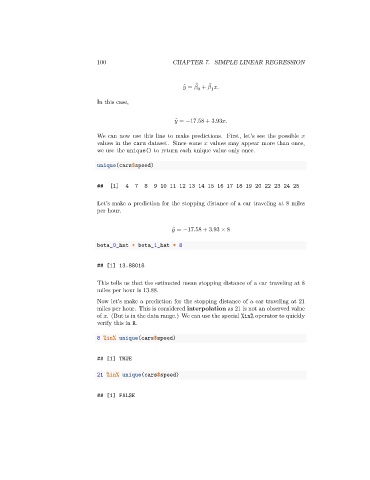
                                                            ̂    = −17.58 + 3.93  .

                                 We can now use this line to make predictions. First, let’s see the possible
                                 values in the cars dataset. Since some    values may appear more than once,
                                 we use the unique() to return each unique value only once.


                                 unique(cars$speed)


                                 ##  [1]   4  7  8  9 10 11 12 13 14 15 16 17 18 19 20 22 23 24 25

                                 Let’s make a prediction for the stopping distance of a car traveling at 8 miles
                                 per hour.


                                                           ̂    = −17.58 + 3.93 × 8

                                 beta_0_hat + beta_1_hat * 8


                                 ## [1] 13.88018


                                 This tells us that the estimated mean stopping distance of a car traveling at 8
                                 miles per hour is 13.88.

                                 Now let’s make a prediction for the stopping distance of a car traveling at 21
                                 miles per hour. This is considered interpolation as 21 is not an observed value
                                 of   . (But is in the data range.) We can use the special %in% operator to quickly
                                 verify this in R.

                                 8 %in% unique(cars$speed)


                                 ## [1] TRUE


                                 21 %in% unique(cars$speed)


                                 ## [1] FALSE

