


Page 147 - First Aid for the USMLE Step 1 2020, Thirtieth edition [MedicalBooksVN.com]_Neat
P. 147
Immunology  ` Immunology—cellular componentS  Immunology  ` Immunology—cellular componentS            SECTIon II       103


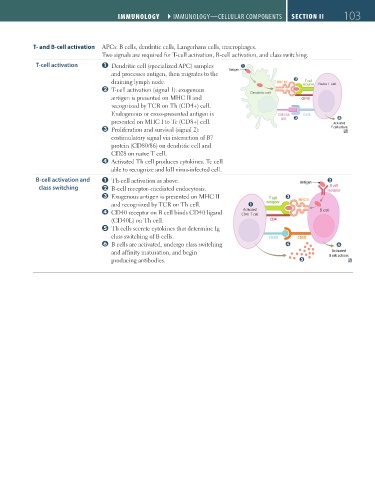
                  T- and B-cell activation  APCs: B cells, dendritic cells, Langerhans cells, macrophages.
                                         Two signals are required for T-cell activation, B-cell activation, and class switching.
                   T-cell activation          Dendritic cell (specialized APC) samples   Q
                                            and processes antigen, then migrates to the   Antigen
                                            draining lymph node.                                  MHC II/I  R  receptor  Naive T cell
                                                                                                           T cell
                                              T-cell activation (signal 1): exogenous    Dendritic cell
                                            antigen is presented on MHC II and                            CD4/8
                                            recognized by TCR on Th (CD4+) cell.
                                            Endogenous or cross-presented antigen is              CD80/86  CD28
                                                                                                                      T
                                            presented on MHC I to Tc (CD8+) cell.                  (B7)  S          Activated
                                              Proliferation and survival (signal 2):                                T cell actions
                                            costimulatory signal via interaction of B7
                                            protein (CD80/86) on dendritic cell and
                                            CD28 on naïve T cell.
                                              Activated Th cell produces cytokines. Tc cell
                                            able to recognize and kill virus-infected cell.
                   B-cell activation and       Th-cell activation as above.                               Antigen  R
                                                                                                                   B cell
                    class switching           B-cell receptor–mediated endocytosis.                                receptor
                                              Exogenous antigen is presented on MHC II         T cell  S  MHC II
                                            and recognized by TCR on Th cell.            Q     receptor
                                                                                       Activated
                                              CD40 receptor on B cell binds CD40 ligand   CD4+ T cell           B cell
                                            (CD40L) on Th cell.                                 CD4
                                              Th cells secrete cytokines that determine Ig
                                            class switching of B cells.                        CD40L     CD40
                                              B cells are activated, undergo class switching         T               V
                                                                                                                    Activated
                                            and affinity maturation, and begin                                     B cell actions
                                            producing antibodies.                                        U


          FAS1_2019_02-Immunology.indd   103                                                                            11/7/19   3:24 PM

