


Page 149 - First Aid for the USMLE Step 1 2020, Thirtieth edition [MedicalBooksVN.com]_Neat
P. 149
Immunology  ` Immunology—Immune reSponSeS       Immunology  ` Immunology—Immune reSponSeS             SECTIon II       105


                  Immunoglobulin         All isotypes can exist as monomers. Mature, naïve B cells prior to activation express IgM and IgD
                  isotypes                on their surfaces. They may differentiate in germinal centers of lymph nodes by isotype switching
                                          (gene rearrangement; induced by cytokines and CD40L) into plasma cells that secrete IgA, IgE,
                                          or IgG.
                                         Affinity refers to the individual antibody-antigen interaction, while avidity describes the cumulative
                                          binding strength of all antibody-antigen interactions in a multivalent molecule.
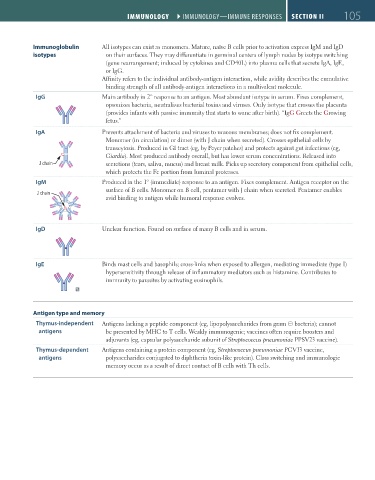
                   IgG                   Main antibody in 2° response to an antigen. Most abundant isotype in serum. Fixes complement,
                                          opsonizes bacteria, neutralizes bacterial toxins and viruses. Only isotype that crosses the placenta
                                          (provides infants with passive immunity that starts to wane after birth). “IgG Greets the Growing
                                          fetus.”
                   IgA                   Prevents attachment of bacteria and viruses to mucous membranes; does not fix complement.
                                          Monomer (in circulation) or dimer (with J chain when secreted). Crosses epithelial cells by
                                          transcytosis. Produced in GI tract (eg, by Peyer patches) and protects against gut infections (eg,
                                          Giardia). Most produced antibody overall, but has lower serum concentrations. Released into
                    J chain               secretions (tears, saliva, mucus) and breast milk. Picks up secretory component from epithelial cells,
                                          which protects the Fc portion from luminal proteases.
                   IgM                   Produced in the 1° (immediate) response to an antigen. Fixes complement. Antigen receptor on the
                                          surface of B cells. Monomer on B cell, pentamer with J chain when secreted. Pentamer enables
                    J chain
                                          avid binding to antigen while humoral response evolves.


                   IgD                   Unclear function. Found on surface of many B cells and in serum.


                   IgE                   Binds mast cells and basophils; cross-links when exposed to allergen, mediating immediate (type I)
                                          hypersensitivity through release of inflammatory mediators such as histamine. Contributes to
                                          immunity to parasites by activating eosinophils.


                  Antigen type and memory
                   Thymus-independent    Antigens lacking a peptide component (eg, lipopolysaccharides from gram ⊝ bacteria); cannot
                    antigens              be presented by MHC to T cells. Weakly immunogenic; vaccines often require boosters and
                                          adjuvants (eg, capsular polysaccharide subunit of Streptococcus pneumoniae PPSV23 vaccine).

                   Thymus-dependent      Antigens containing a protein component (eg, Streptococcus pneumoniae PCV13 vaccine,
                    antigens              polysaccharides conjugated to diphtheria toxin-like protein). Class switching and immunologic
                                          memory occur as a result of direct contact of B cells with Th cells.


          FAS1_2019_02-Immunology.indd   105                                                                            11/7/19   3:24 PM

