Page 153 - First Aid for the USMLE Step 1 2020, Thirtieth edition [MedicalBooksVN.com]_Neat
P. 153
Immunology  ` Immunology—Immune reSponSeS       Immunology  ` Immunology—Immune reSponSeS             SECTIon II       109


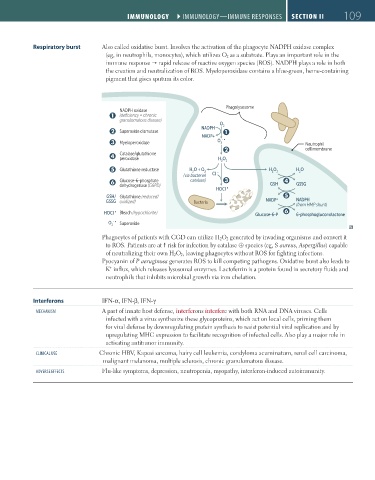
                  Respiratory burst      Also called oxidative burst. Involves the activation of the phagocyte NADPH oxidase complex
                                          (eg, in neutrophils, monocytes), which utilizes O 2  as a substrate. Plays an important role in the
                                          immune response Ž rapid release of reactive oxygen species (ROS). NADPH plays a role in both
                                          the creation and neutralization of ROS. Myeloperoxidase contains a blue-green, heme-containing
                                          pigment that gives sputum its color.


                                                                                 Phagolysosome
                                               NADPH oxidase
                                           Q   (deficiency = chronic
                                               granulomatous disease)
                                                                               O 2
                                                                         NADPH
                                           R   Superoxide dismutase             Q
                                                                          NADP+
                                           S   Myeloperoxidase                 O 2 - ∞                     Neutrophil
                                                                                R                          cell membrane
                                           T   Catalase/glutathione
                                               peroxidase                      H O
                                                                                2 2
                                           U   Glutathione reductase  H O + O 2  –             H O      H O
                                                                      2
                                                                                                2 2
                                                                                                         2
                                                                    (via bacterial  Cl
                                           V   Glucose-6-phosphate    catalase)  S              GSH  T  GSSG
                                               dehydrogenase (G6PD)               ∞
                                                                              HOCl
                                          GSH/ Glutathione (reduced/                              +  U
                                          GSSG oxidized)               Bacteria               NADP      NADPH
                                                                                                        (from HMP shunt)
                                          HOCl  Bleach (hypochlorite)                      Glucose-6-P  V  6-phosphogluconolactone
                                             ∞
                                           O 2 - ∞  Superoxide
                                         Phagocytes of patients with CGD can utilize H 2 O 2  generated by invading organisms and convert it
                                          to ROS. Patients are at  risk for infection by catalase ⊕ species (eg, S aureus, Aspergillus) capable
                                          of neutralizing their own H 2 O 2 , leaving phagocytes without ROS for fighting infections.
                                         Pyocyanin of P aeruginosa generates ROS to kill competing pathogens. Oxidative burst also leads to
                                          K  influx, which releases lysosomal enzymes. Lactoferrin is a protein found in secretory fluids and
                                           +
                                          neutrophils that inhibits microbial growth via iron chelation.


                  Interferons            IFN-α, IFN-β, IFN-γ
                   mechanISm             A part of innate host defense, interferons interfere with both RNA and DNA viruses. Cells
                                          infected with a virus synthesize these glycoproteins, which act on local cells, priming them
                                          for viral defense by downregulating protein synthesis to resist potential viral replication and by
                                          upregulating MHC expression to facilitate recognition of infected cells. Also play a major role in
                                          activating antitumor immunity.

                   clInIcal uSe         Chronic HBV, Kaposi sarcoma, hairy cell leukemia, condyloma acuminatum, renal cell carcinoma,
                                         malignant melanoma, multiple sclerosis, chronic granulomatous disease.
                   adVerSe eFFectS       Flu-like symptoms, depression, neutropenia, myopathy, interferon-induced autoimmunity.


          FAS1_2019_02-Immunology.indd   109                                                                            11/7/19   3:24 PM
   148   149   150   151   152   153   154   155   156   157   158