


Page 250 - First Aid for the USMLE Step 1 2020, Thirtieth edition [MedicalBooksVN.com]_Neat
P. 250
206 SECtIoN II Pathology ` PATHOLOGY—CeLLuLAr InjurY Pathology ` PATHOLOGY—CeLLuLAr InjurY
` PATHOLOGY—CeLLuLAr InjurY
Cellular adaptations Reversible changes that can be physiologic (eg, uterine enlargement during pregnancy) or pathologic
(eg, myocardial hypertrophy 2° to systemic HTN). If stress is excessive or persistent, adaptations
can progress to cell injury (eg, significant LV hypertrophy injury to myofibrils HF).
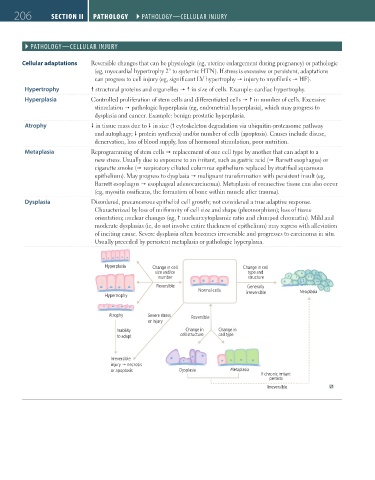
Hypertrophy structural proteins and organelles in size of cells. Example: cardiac hypertrophy.
Hyperplasia Controlled proliferation of stem cells and differentiated cells in number of cells. Excessive
stimulation pathologic hyperplasia (eg, endometrial hyperplasia), which may progress to
dysplasia and cancer. Example: benign prostatic hyperplasia.
Atrophy in tissue mass due to in size ( cytoskeleton degradation via ubiquitin- proteasome pathway
and autophagy; protein synthesis) and/or number of cells (apoptosis). Causes include disuse,
denervation, loss of blood supply, loss of hormonal stimulation, poor nutrition.
Metaplasia Reprogramming of stem cells replacement of one cell type by another that can adapt to a
new stress. Usually due to exposure to an irritant, such as gastric acid ( Barrett esophagus) or
cigarette smoke ( respiratory ciliated columnar epithelium replaced by stratified squamous
epithelium). May progress to dysplasia malignant transformation with persistent insult (eg,
Barrett esophagus esophageal adenocarcinoma). Metaplasia of connective tissue can also occur
(eg, myositis ossificans, the formation of bone within muscle after trauma).
Dysplasia Disordered, precancerous epithelial cell growth; not considered a true adaptive response.
Characterized by loss of uniformity of cell size and shape (pleomorphism); loss of tissue
orientation; nuclear changes (eg, nuclear:cytoplasmic ratio and clumped chromatin). Mild and
moderate dysplasias (ie, do not involve entire thickness of epithelium) may regress with alleviation
of inciting cause. Severe dysplasia often becomes irreversible and progresses to carcinoma in situ.
Usually preceded by persistent metaplasia or pathologic hyperplasia.
Hyperplasia Change in cell Change in cell
size and/or type and
number structure
Reversible Generally
Normal cells irreversible Neoplasia
Hypertrophy
Atrophy Severe stress Reversible
or injury
Inability Change in Change in
to adapt cell structure cell type
Irreversible
injury necrosis
or apoptosis Dysplasia Metaplasia
If chronic irritant
persists
Irreversible
FAS1_2019_04-Pathol.indd 206 11/7/19 4:02 PM

