


Page 252 - First Aid for the USMLE Step 1 2020, Thirtieth edition [MedicalBooksVN.com]_Neat
P. 252
208 SECtIoN II Pathology ` PATHOLOGY—CeLLuLAr InjurY Pathology ` PATHOLOGY—CeLLuLAr InjurY
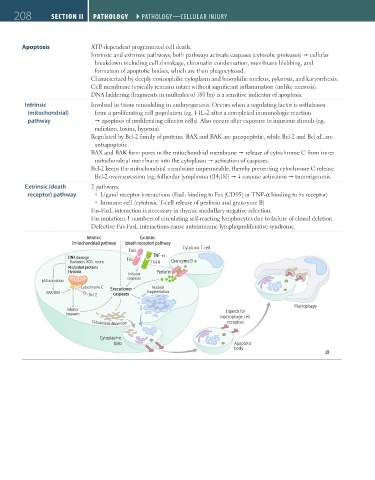
Apoptosis ATP-dependent programmed cell death.
Intrinsic and extrinsic pathways; both pathways activate caspases (cytosolic proteases) cellular
breakdown including cell shrinkage, chromatin condensation, membrane blebbing, and
formation of apoptotic bodies, which are then phagocytosed.
Characterized by deeply eosinophilic cytoplasm and basophilic nucleus, pyknosis, and karyorrhexis.
Cell membrane typically remains intact without significant inflammation (unlike necrosis).
DNA laddering (fragments in multiples of 180 bp) is a sensitive indicator of apoptosis.
Intrinsic Involved in tissue remodeling in embryogenesis. Occurs when a regulating factor is withdrawn
(mitochondrial) from a proliferating cell population (eg, IL-2 after a completed immunologic reaction
pathway apoptosis of proliferating effector cells). Also occurs after exposure to injurious stimuli (eg,
radiation, toxins, hypoxia).
Regulated by Bcl-2 family of proteins. BAX and BAK are proapoptotic, while Bcl-2 and Bcl-xL are
antiapoptotic.
BAX and BAK form pores in the mitochondrial membrane release of cytochrome C from inner
mitochondrial membrane into the cytoplasm activation of caspases.
Bcl-2 keeps the mitochondrial membrane impermeable, thereby preventing cytochrome C release.
Bcl-2 overexpression (eg, follicular lymphoma t[14;18]) caspase activation tumorigenesis.
Extrinsic (death 2 pathways:
receptor) pathway Ligand receptor interactions (FasL binding to Fas [CD95] or TNF-α binding to its receptor)
Immune cell (cytotoxic T-cell release of perforin and granzyme B)
Fas-FasL interaction is necessary in thymic medullary negative selection.
Fas mutations numbers of circulating self-reacting lymphocytes due to failure of clonal deletion.
Defective Fas-FasL interactions cause autoimmune lymphoproliferative syndrome.
Intrinsic Extrinsic
(mitochondrial) pathway (death receptor) pathway
FasL Cytotoxic T cell
TNF-α
DNA damage Fas
Radiation, ROS, toxins TNFR Granzyme B
Misfolded proteins
Hypoxia Perforin
Initiator
caspases
p53 activation
Cytochrome C Executioner Nuclear
BAX/BAK caspases fragmentation
Bcl-2
Macrophage
Initiator Ligands for
caspases
macrophage cell
receptors
Cytoskeletal dispersion
Cytoplasmic
bleb Apoptotic
body
FAS1_2019_04-Pathol.indd 208 11/7/19 4:02 PM

