


Page 258 - First Aid for the USMLE Step 1 2020, Thirtieth edition [MedicalBooksVN.com]_Neat
P. 258
214 SECtIoN II Pathology ` PATHOLOGY—InfLAMMATIOn Pathology ` PATHOLOGY—InfLAMMATIOn
Erythrocyte RBCs normally remain separated via ⊝ charges. Products of inflammation (eg, fibrinogen) coat
sedimentation rate RBCs ⊝ charge RBC aggregation. Denser RBC aggregates fall at a faster rate within a
pipette tube ESR. Often co-tested with CRP (more specific marker of inflammation).
ESR ESR
Most anemias Sickle cell anemia (altered shape)
Infections Polycythemia ( RBCs “dilute” aggregation
Inflammation (eg, giant cell [temporal] arteritis, factors)
polymyalgia rheumatica) HF
Cancer (eg, metastases, multiple myeloma) Microcytosis
Renal disease (end-stage or nephrotic syndrome) Hypofibrinogenemia
Pregnancy
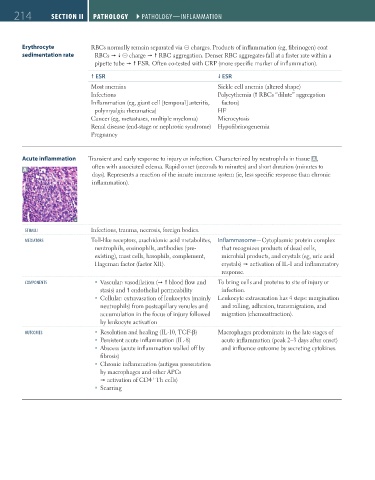
Acute inflammation Transient and early response to injury or infection. Characterized by neutrophils in tissue A ,
A often with associated edema. Rapid onset (seconds to minutes) and short duration (minutes to
days). Represents a reaction of the innate immune system (ie, less specific response than chronic
inflammation).
STIMuLI Infections, trauma, necrosis, foreign bodies.
MeDIATOrS Toll-like receptors, arachidonic acid metabolites, Inflammasome—Cytoplasmic protein complex
neutrophils, eosinophils, antibodies (pre- that recognizes products of dead cells,
existing), mast cells, basophils, complement, microbial products, and crystals (eg, uric acid
Hageman factor (factor XII). crystals) activation of IL-1 and inflammatory
response.
COMPOnenTS Vascular: vasodilation ( blood flow and To bring cells and proteins to site of injury or
stasis) and endothelial permeability infection.
Cellular: extravasation of leukocytes (mainly Leukocyte extravasation has 4 steps: margination
neutrophils) from postcapillary venules and and rolling, adhesion, transmigration, and
accumulation in the focus of injury followed migration (chemoattraction).
by leukocyte activation
OuTCOMeS Resolution and healing (IL-10, TGF-β) Macrophages predominate in the late stages of
Persistent acute inflammation (IL-8) acute inflammation (peak 2–3 days after onset)
Abscess (acute inflammation walled off by and influence outcome by secreting cytokines.
fibrosis)
Chronic inflammation (antigen presentation
by macrophages and other APCs
+
activation of CD4 Th cells)
Scarring
FAS1_2019_04-Pathol.indd 214 11/7/19 4:02 PM

