


Page 440 - First Aid for the USMLE Step 1 2020, Thirtieth edition [MedicalBooksVN.com]_Neat
P. 440
396 seCtion iii Gastrointestinal ` gastrointestinal—PatHology Gastrointestinal ` gastrointestinal—PatHology
Cholelithiasis and cholesterol and/or bilirubin, bile salts, and Gender (female), Chronic hemolysis,
related pathologies gallbladder stasis all cause stones. age, obesity, genetics, biliary tract infection
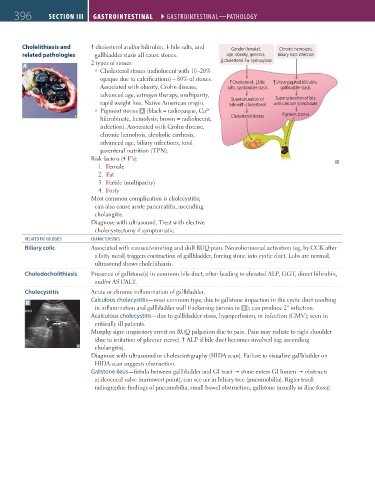
A 2 types of stones: ↓cholesterol 7α hydroxylase
Cholesterol stones (radiolucent with 10–20%
opaque due to calcifications)—80% of stones. ↑Cholesterol, ↓bile ↑Unconjugated bilirubin,
Associated with obesity, Crohn disease, salts, gallbladder stasis gallbladder stasis
advanced age, estrogen therapy, multiparity, Supersaturation of bile
Supersaturation of
rapid weight loss, Native American origin. bile with cholesterol with calcium bilirubinate
Pigment stones A (black = radiopaque, Ca
2+
bilirubinate, hemolysis; brown = radiolucent, Cholesterol stones Pigment stones
infection). Associated with Crohn disease,
chronic hemolysis, alcoholic cirrhosis,
advanced age, biliary infections, total
parenteral nutrition (TPN).
Risk factors (4 F’s):
1. Female
2. Fat
3. Fertile (multiparity)
4. Forty
Most common complication is cholecystitis;
can also cause acute pancreatitis, ascending
cholangitis.
Diagnose with ultrasound. Treat with elective
cholecystectomy if symptomatic.
relateD PatHologies CHaraCteristiCs
Biliary colic Associated with nausea/vomiting and dull RUQ pain. Neurohormonal activation (eg, by CCK after
a fatty meal) triggers contraction of gallbladder, forcing stone into cystic duct. Labs are normal,
ultrasound shows cholelithiasis.
Choledocholithiasis Presence of gallstone(s) in common bile duct, often leading to elevated ALP, GGT, direct bilirubin,
and/or AST/ALT.
Cholecystitis Acute or chronic inflammation of gallbladder.
Calculous cholecystitis—most common type; due to gallstone impaction in the cystic duct resulting
B
in inflammation and gallbladder wall thickening (arrows in B ); can produce 2° infection.
Acalculous cholecystitis—due to gallbladder stasis, hypoperfusion, or infection (CMV); seen in
critically ill patients.
Murphy sign: inspiratory arrest on RUQ palpation due to pain. Pain may radiate to right shoulder
(due to irritation of phrenic nerve). ALP if bile duct becomes involved (eg, ascending
cholangitis).
Diagnose with ultrasound or cholescintigraphy (HIDA scan). Failure to visualize gallbladder on
HIDA scan suggests obstruction.
Gallstone ileus—fistula between gallbladder and GI tract stone enters GI lumen obstructs
at ileocecal valve (narrowest point); can see air in biliary tree (pneumobilia). Rigler triad:
radiographic findings of pneumobilia, small bowel obstruction, gallstone (usually in iliac fossa).
FAS1_2019_09-Gastrointestinal.indd 396 11/7/19 4:42 PM

