


Page 437 - First Aid for the USMLE Step 1 2020, Thirtieth edition [MedicalBooksVN.com]_Neat
P. 437
Gastrointestinal ` gastrointestinal—PatHology Gastrointestinal ` gastrointestinal—PatHology seCtion iii 393
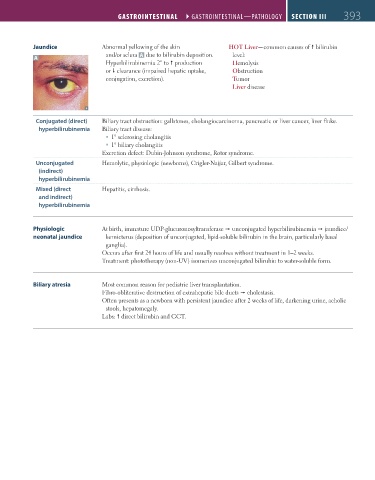
Jaundice Abnormal yellowing of the skin HOT Liver—common causes of bilirubin
and/or sclera A due to bilirubin deposition. level:
A
Hyperbilirubinemia 2° to production Hemolysis
or clearance (impaired hepatic uptake, Obstruction
conjugation, excretion). Tumor
Liver disease
Conjugated (direct) Biliary tract obstruction: gallstones, cholangiocarcinoma, pancreatic or liver cancer, liver fluke.
hyperbilirubinemia Biliary tract disease:
1° sclerosing cholangitis
1° biliary cholangitis
Excretion defect: Dubin-Johnson syndrome, Rotor syndrome.
Unconjugated Hemolytic, physiologic (newborns), Crigler-Najjar, Gilbert syndrome.
(indirect)
hyperbilirubinemia
Mixed (direct Hepatitis, cirrhosis.
and indirect)
hyperbilirubinemia
Physiologic At birth, immature UDP-glucuronosyltransferase unconjugated hyperbilirubinemia jaundice/
neonatal jaundice kernicterus (deposition of unconjugated, lipid-soluble bilirubin in the brain, particularly basal
ganglia).
Occurs after first 24 hours of life and usually resolves without treatment in 1–2 weeks.
Treatment: phototherapy (non-UV) isomerizes unconjugated bilirubin to water-soluble form.
Biliary atresia Most common reason for pediatric liver transplantation.
Fibro-obliterative destruction of extrahepatic bile ducts cholestasis.
Often presents as a newborn with persistent jaundice after 2 weeks of life, darkening urine, acholic
stools, hepatomegaly.
Labs: direct bilirubin and GGT.
FAS1_2019_09-Gastrointestinal.indd 393 11/7/19 4:42 PM

