


Page 457 - First Aid for the USMLE Step 1 2020, Thirtieth edition [MedicalBooksVN.com]_Neat
P. 457
Hematology and oncology ` hematology and oncology—PhySIology Hematology and oncology ` hematology and oncology—PhySIology SectIon III 413
Vitamin K–dependent coagulation
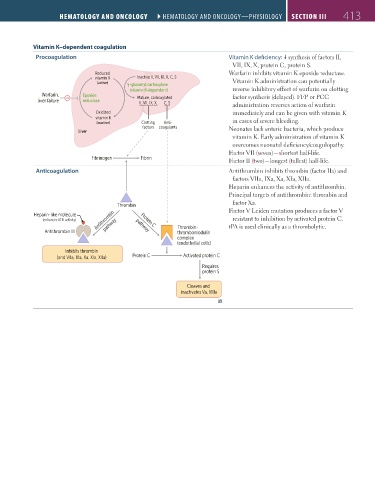
Procoagulation Vitamin K deficiency: synthesis of factors II,
VII, IX, X, protein C, protein S.
Reduced Warfarin inhibits vitamin K epoxide reductase.
vitamin K Inactive II, VII, IX, X, C, S Vitamin K administration can potentially
(active) -glutamyl carboxylase
(vitamin K-dependent) reverse inhibitory effect of warfarin on clotting
Warfarin, Epoxide factor synthesis (delayed). FFP or PCC
liver failure reductase Mature, carboxylated administration reverses action of warfarin
II, VII, IX, X, C, S
Oxidized immediately and can be given with vitamin K
vitamin K in cases of severe bleeding.
(inactive) Clotting Anti-
factors coagulants Neonates lack enteric bacteria, which produce
Liver
vitamin K. Early administration of vitamin K
overcomes neonatal deficiency/coagulopathy.
Factor VII (seven)—shortest half-life.
Fibrinogen Fibrin
Factor II (two)—longest (tallest) half-life.
Anticoagulation Antithrombin inhibits thrombin (factor IIa) and
factors VIIa, IXa, Xa, XIa, XIIa.
Heparin enhances the activity of antithrombin.
Principal targets of antithrombin: thrombin and
factor Xa.
Thrombin
Heparin-like molecule Factor V Leiden mutation produces a factor V
pathway
(enhances ATIII activity) Antithrombin Protein C resistant to inhibition by activated protein C.
Antithrombin III pathway Thrombin- tPA is used clinically as a thrombolytic.
thrombomodulin
complex
(endothelial cells)
Inhibits thrombin
(and VIIa, IXa, Xa, XIa, XIIa) Protein C Activated protein C
Requires
protein S
Cleaves and
inactivates Va, VIIIa
FAS1_2019_10-HemaOncol.indd 413 11/7/19 5:04 PM

