Page 497 - First Aid for the USMLE Step 1 2020, Thirtieth edition [MedicalBooksVN.com]_Neat
P. 497
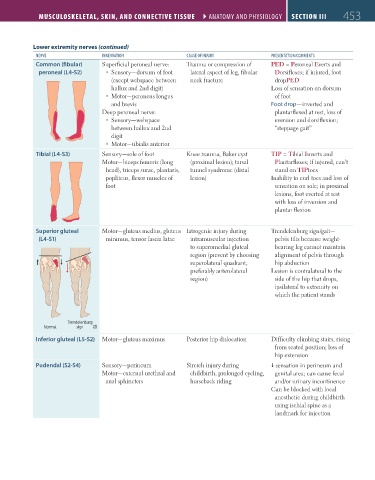
Musculoskeletal, skin, and connective tissue  ` anatomy and physiology  Musculoskeletal, skin, and connective tissue  ` anatomy and physiology  section iii  453


                  Lower extremity nerves (continued)
                   nERVE                 innERVation                 CaUsE oF inJURy            pREsEntation/CommEnts
                   Common (fibular)      Superficial peroneal nerve:   Trauma or compression of   PED = Peroneal Everts and
                    peroneal (L4-S2)         ƒ Sensory—dorsum of foot   lateral aspect of leg, fibular   Dorsiflexes; if injured, foot
                                            (except webspace between   neck fracture             dropPED
                                            hallux and 2nd digit)                               Loss of sensation on dorsum
                                             ƒ Motor—peroneus longus                             of foot
                                            and brevis                                          Foot drop—inverted and
                                         Deep peroneal nerve:                                    plantarflexed at rest, loss of
                                             ƒ Sensory—webspace                                  eversion and dorsiflexion;
                                            between hallux and 2nd                               “steppage gait”
                                            digit
                                             ƒ Motor—tibialis anterior
                   Tibial (L4-S3)        Sensory—sole of foot       Knee trauma, Baker cyst     TIP = Tibial Inverts and
                                         Motor—biceps femoris (long   (proximal lesion); tarsal   Plantarflexes; if injured, can’t
                                          head), triceps surae, plantaris,   tunnel syndrome (distal   stand on TIPtoes
                                          popliteus, flexor muscles of   lesion)                Inability to curl toes and loss of
                                          foot                                                   sensation on sole; in proximal
                                                                                                 lesions, foot everted at rest
                                                                                                 with loss of inversion and
                                                                                                 plantar flexion


                   Superior gluteal      Motor—gluteus medius, gluteus  Iatrogenic injury during   Trendelenburg sign/gait—
                    (L4-S1)               minimus, tensor fascia latae  intramuscular injection   pelvis tilts because weight-
                                                                      to superomedial gluteal    bearing leg cannot maintain
                                                                      region (prevent by choosing   alignment of pelvis through
                                                                      superolateral quadrant,    hip abduction
                                                                      preferably anterolateral   Lesion is contralateral to the
                                                                      region)                    side of the hip that drops,
                                                                                                 ipsilateral to extremity on
                                                                                                 which the patient stands


                              Trendelenburg
                      Normal     sign
                   Inferior gluteal (L5-S2)  Motor—gluteus maximus  Posterior hip dislocation   Difficulty climbing stairs, rising
                                                                                                 from seated position; loss of
                                                                                                 hip extension
                   Pudendal (S2-S4)      Sensory—perineum           Stretch injury during        sensation in perineum and
                                         Motor—external urethral and   childbirth, prolonged cycling,   genital area; can cause fecal
                                          anal sphincters             horseback riding           and/or urinary incontinence
                                                                                                Can be blocked with local
                                                                                                 anesthetic during childbirth
                                                                                                 using ischial spine as a
                                                                                                 landmark for injection


          FAS1_2019_11-Musculo.indd   453                                                                               11/7/19   5:23 PM
   492   493   494   495   496   497   498   499   500   501   502