


Page 498 - First Aid for the USMLE Step 1 2020, Thirtieth edition [MedicalBooksVN.com]_Neat
P. 498
454 section iii Musculoskeletal, skin, and connective tissue ` anatomy and physiology Musculoskeletal, skin, and connective tissue ` anatomy and physiology
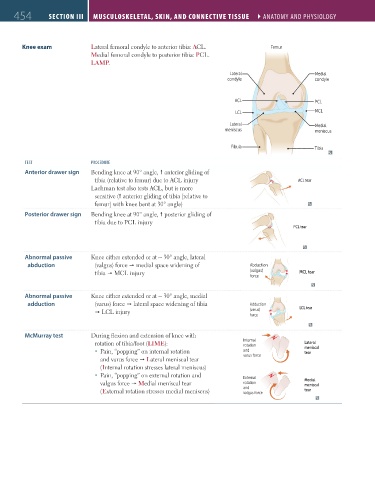
Knee exam Lateral femoral condyle to anterior tibia: ACL. Femur
Medial femoral condyle to posterior tibia: PCL.
LAMP.
Lateral Medial
condyle condyle
ACL PCL
LCL MCL
Lateral Medial
meniscus meniscus
Fibula Tibia
tEst pRoCEdURE
Anterior drawer sign Bending knee at 90° angle, anterior gliding of
tibia (relative to femur) due to ACL injury ACL tear
Lachman test also tests ACL, but is more
sensitive ( anterior gliding of tibia [relative to
femur] with knee bent at 30° angle)
Posterior drawer sign Bending knee at 90° angle, posterior gliding of
tibia due to PCL injury
PCL tear
Abnormal passive Knee either extended or at ~ 30° angle, lateral
abduction (valgus) force medial space widening of Abduction
tibia MCL injury (valgus) MCL tear
force
Abnormal passive Knee either extended or at ~ 30° angle, medial
adduction (varus) force lateral space widening of tibia Adduction
LCL injury (varus) LCL tear
force
McMurray test During flexion and extension of knee with
rotation of tibia/foot (LIME): Internal Lateral
rotation
Pain, “popping” on internal rotation and meniscal
tear
and varus force Lateral meniscal tear varus force
(Internal rotation stresses lateral meniscus)
Pain, “popping” on external rotation and External
valgus force Medial meniscal tear rotation Medial
meniscal
(External rotation stresses medial meniscus) and tear
valgus force
FAS1_2019_11-Musculo.indd 454 11/7/19 5:23 PM

