


Page 506 - First Aid for the USMLE Step 1 2020, Thirtieth edition [MedicalBooksVN.com]_Neat
P. 506
462 section iii Musculoskeletal, skin, and connective tissue ` pathology Musculoskeletal, skin, and connective tissue ` pathology
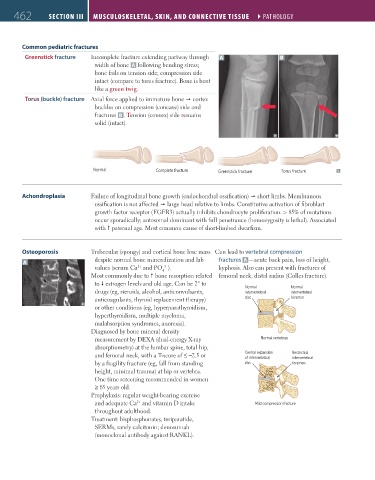
Common pediatric fractures
Greenstick fracture Incomplete fracture extending partway through A B
width of bone A following bending stress;
Normal
bone fails on tension side; compression side
intact (compare to torus fracture). Bone is bent
like a green twig.
Torus (buckle) fracture Axial force applied to immature bone cortex
Greenstick fracture
buckles on compression (concave) side and Normal
fractures B . Tension (convex) side remains
solid (intact).
Torus fracture Greenstick fracture
Normal
Normal Complete fracture Greenstick fracture Torus fracture
Achondroplasia Failure of longitudinal bone growth (endochondral ossification) short limbs. Membranous
Greenstick fracture
ossification is not affected large head relative to limbs. Constitutive activation of fibroblast
Torus fracture
Complete fracture
growth factor receptor (FGFR3) actually inhibits chondrocyte proliferation. > 85% of mutations
occur sporadically; autosomal dominant with full penetrance (homozygosity is lethal). Associated
with paternal age. Most common cause of short-limbed dwarfism.
Torus fracture
Complete fracture
Osteoporosis Trabecular (spongy) and cortical bone lose mass Can lead to vertebral compression
A despite normal bone mineralization and lab fractures A —acute back pain, loss of height,
values (serum Ca and PO ). kyphosis. Also can present with fractures of
3−
2+
Complete fracture 4
Most commonly due to bone resorption related femoral neck, distal radius (Colles fracture).
to estrogen levels and old age. Can be 2° to
Central expansion Restricted Normal Normal
drugs (eg, steroids, alcohol, anticonvulsants, intervertebral intervertebral intervertebral
of intervertebral
disc
anticoagulants, thyroid replacement therapy) foramen disc foramen
or other conditions (eg, hyperparathyroidism,
hyperthyroidism, multiple myeloma,
malabsorption syndromes, anorexia).
Diagnosed by bone mineral density
measurement by DEXA (dual-energy X-ray Normal vertebrae
Mild compression fracture
absorptiometry) at the lumbar spine, total hip,
and femoral neck, with a T-score of ≤ −2.5 or Central expansion Restricted Normal Normal
intervertebral
of intervertebral
intervertebral
intervertebral
by a fragility fracture (eg, fall from standing disc foramen disc foramen
height, minimal trauma) at hip or vertebra.
One time screening recommended in women
≥ 65 years old.
Prophylaxis: regular weight-bearing exercise
and adequate Ca and vitamin D intake Mild compression fracture Normal vertebrae
2+
throughout adulthood.
Treatment: bisphosphonates, teriparatide,
SERMs, rarely calcitonin; denosumab
(monoclonal antibody against RANKL).
FAS1_2019_11-Musculo.indd 462 11/7/19 5:23 PM

