


Page 509 - First Aid for the USMLE Step 1 2020, Thirtieth edition [MedicalBooksVN.com]_Neat
P. 509
Musculoskeletal, skin, and connective tissue  ` pathology  Musculoskeletal, skin, and connective tissue  ` pathology  section iii  465


                  Primary bone tumors (continued)
                   tUmoR typE            EpidEmiology           loCation                  ChaRaCtERistiCs
                   Malignant tumors
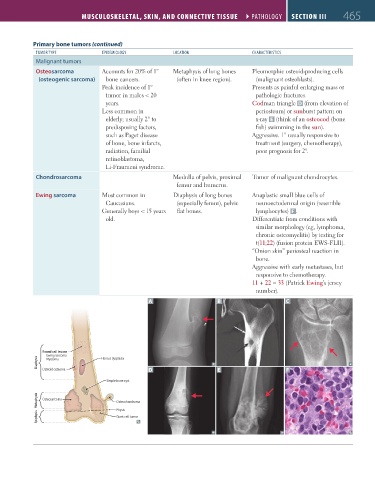
                   Osteosarcoma          Accounts for 20% of 1°   Metaphysis of long bones   Pleomorphic osteoid-producing cells
                    (osteogenic sarcoma)  bone cancers.          (often in knee region).   (malignant osteoblasts).
                                         Peak incidence of 1°                             Presents as painful enlarging mass or
                                          tumor in males < 20                              pathologic fractures.
                                          years.                                          Codman triangle  D (from elevation of
                                         Less common in                                    periosteum) or sunburst pattern on
                                          elderly; usually 2° to                           x-ray  E  (think of an osteocod (bone
                                          predisposing factors,                            fish) swimming in the sun).
                                          such as Paget disease                           Aggressive. 1° usually responsive to
                                          of bone, bone infarcts,                          treatment (surgery, chemotherapy),
                                          radiation, familial                              poor prognosis for 2°.
                                          retinoblastoma,
                                          Li-Fraumeni syndrome.
                   Chondrosarcoma                               Medulla of pelvis, proximal   Tumor of malignant chondrocytes.
                                                                 femur and humerus.
                   Ewing sarcoma         Most common in         Diaphysis of long bones   Anaplastic small blue cells of
                                          Caucasians.            (especially femur), pelvic   neuroectodermal origin (resemble
                                         Generally boys < 15 years   flat bones.           lymphocytes)  F .
                                          old.                                            Differentiate from conditions with
                                                                                           similar morphology (eg, lymphoma,
                                                                                           chronic osteomyelitis) by testing for
                                                                                           t(11;22) (fusion protein EWS-FLI1).
                                                                                          “Onion skin” periosteal reaction in
                                                                                           bone.
                                                                                          Aggressive with early metastases, but
                                                                                           responsive to chemotherapy.
                                                                                          11 + 22 = 33 (Patrick Ewing’s jersey
                                                                                           number).
                                                        A                      B                     C


                     Round cell lesions
                       Ewing sarcoma     Fibrous dysplasia
                    Diaphysis   Myeloma                 D                      E                     F
                     Osteoid osteoma
                                          Simple bone cyst

                    Metaphysis  Osteosarcoma  Osteochondroma

                                              Physis
                    Epiphysis                 Giant cell tumor


          FAS1_2019_11-Musculo.indd   465                                                                               11/7/19   5:23 PM

