


Page 508 - First Aid for the USMLE Step 1 2020, Thirtieth edition [MedicalBooksVN.com]_Neat
P. 508
464 section iii Musculoskeletal, skin, and connective tissue ` pathology Musculoskeletal, skin, and connective tissue ` pathology
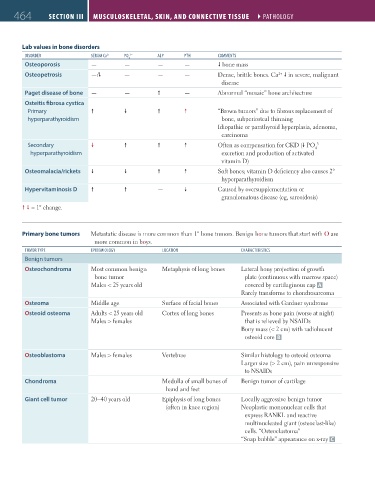
Lab values in bone disorders
disoRdER sERUm Ca 2+ po 3− alp pth CommEnts
4
Osteoporosis — — — — bone mass
Osteopetrosis —/ — — — Dense, brittle bones. Ca in severe, malignant
2+
disease
Paget disease of bone — — — Abnormal “mosaic” bone architecture
Osteitis fibrosa cystica
Primary “Brown tumors” due to fibrous replacement of
hyperparathyroidism bone, subperiosteal thinning
Idiopathic or parathyroid hyperplasia, adenoma,
carcinoma
Secondary Often as compensation for CKD ( PO
3−
4
hyperparathyroidism excretion and production of activated
vitamin D)
Osteomalacia/rickets Soft bones; vitamin D deficiency also causes 2°
hyperparathyroidism
Hypervitaminosis D — Caused by oversupplementation or
granulomatous disease (eg, sarcoidosis)
= 1° change.
Primary bone tumors Metastatic disease is more common than 1° bone tumors. Benign bone tumors that start with O are
more common in boys.
tUmoR typE EpidEmiology loCation ChaRaCtERistiCs
Benign tumors
Osteochondroma Most common benign Metaphysis of long bones Lateral bony projection of growth
bone tumor plate (continuous with marrow space)
Males < 25 years old covered by cartilaginous cap A
Rarely transforms to chondrosarcoma
Osteoma Middle age Surface of facial bones Associated with Gardner syndrome
Osteoid osteoma Adults < 25 years old Cortex of long bones Presents as bone pain (worse at night)
Males > females that is relieved by NSAIDs
Bony mass (< 2 cm) with radiolucent
osteoid core B
Osteoblastoma Males > females Vertebrae Similar histology to osteoid osteoma
Larger size (> 2 cm), pain unresponsive
to NSAIDs
Chondroma Medulla of small bones of Benign tumor of cartilage
hand and feet
Giant cell tumor 20–40 years old Epiphysis of long bones Locally aggressive benign tumor
(often in knee region) Neoplastic mononuclear cells that
express RANKL and reactive
multinucleated giant (osteoclast-like)
cells. “Osteoclastoma”
“Soap bubble” appearance on x-ray C
FAS1_2019_11-Musculo.indd 464 11/7/19 5:23 PM

