


Page 536 - First Aid for the USMLE Step 1 2020, Thirtieth edition [MedicalBooksVN.com]_Neat
P. 536
492 SecTioN iii Neurology aNd Special SeNSeS ` neurology—embryology Neurology aNd Special SeNSeS ` neurology—AnAtomy And Physiology
Posterior fossa malformations
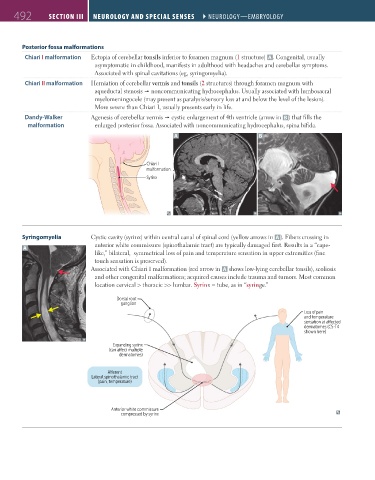
Chiari I malformation Ectopia of cerebellar tonsils inferior to foramen magnum (1 structure) A . Congenital, usually
asymptomatic in childhood, manifests in adulthood with headaches and cerebellar symptoms.
Associated with spinal cavitations (eg, syringomyelia).
Chiari II malformation Herniation of cerebellar vermis and tonsils (2 structures) through foramen magnum with
aqueductal stenosis noncommunicating hydrocephalus. Usually associated with lumbosacral
myelomeningocele (may present as paralysis/sensory loss at and below the level of the lesion).
More severe than Chiari I, usually presents early in life.
Dandy-Walker Agenesis of cerebellar vermis cystic enlargement of 4th ventricle (arrow in B ) that fills the
malformation enlarged posterior fossa. Associated with noncommunicating hydrocephalus, spina bifida.
A B
Chiari I
malformation
Syrinx
Syringomyelia Cystic cavity (syrinx) within central canal of spinal cord (yellow arrows in A ). Fibers crossing in
A anterior white commissure (spinothalamic tract) are typically damaged first. Results in a “cape-
like,” bilateral, symmetrical loss of pain and temperature sensation in upper extremities (fine
touch sensation is preserved).
Associated with Chiari I malformation (red arrow in A shows low-lying cerebellar tonsils), scoliosis
and other congenital malformations; acquired causes include trauma and tumors. Most common
location cervical > thoracic >> lumbar. Syrinx = tube, as in “syringe.”
Dorsal root
ganglion
Loss of pain
and temperature
sensation at a ected
dermatomes (C5-T4
shown here)
Expanding syrinx
(can a ect multiple
dermatomes)
A erent
Lateral spinothalamic tract
(pain, temperature)
Anterior white commissure
compressed by syrinx
FAS1_2019_12-Neurol.indd 492 11/8/19 7:39 AM

