


Page 541 - First Aid for the USMLE Step 1 2020, Thirtieth edition [MedicalBooksVN.com]_Neat
P. 541
Neurology aNd Special SeNSeS ` neurology—AnAtomy And Physiology Neurology aNd Special SeNSeS ` neurology—AnAtomy And Physiology SecTioN iii 497
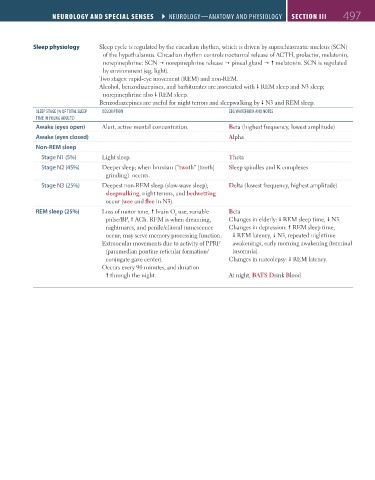
Sleep physiology Sleep cycle is regulated by the circadian rhythm, which is driven by suprachiasmatic nucleus (SCN)
of the hypothalamus. Circadian rhythm controls nocturnal release of ACTH, prolactin, melatonin,
norepinephrine: SCN norepinephrine release pineal gland melatonin. SCN is regulated
by environment (eg, light).
Two stages: rapid-eye movement (REM) and non-REM.
Alcohol, benzodiazepines, and barbiturates are associated with REM sleep and N3 sleep;
norepinephrine also REM sleep.
Benzodiazepines are useful for night terrors and sleepwalking by N3 and REM sleep.
sleeP stAge (% oF totAl sleeP desCriPtion eeg WAVeForm And notes
time in young Adults)
Awake (eyes open) Alert, active mental concentration. Beta (highest frequency, lowest amplitude)
Awake (eyes closed) Alpha
Non-REM sleep
Stage N1 (5%) Light sleep. Theta
Stage N2 (45%) Deeper sleep; when bruxism (“twoth” [tooth] Sleep spindles and K complexes
grinding) occurs.
Stage N3 (25%) Deepest non-REM sleep (slow-wave sleep); Delta (lowest frequency, highest amplitude)
sleepwalking, night terrors, and bedwetting
occur (wee and flee in N3).
REM sleep (25%) Loss of motor tone, brain O use, variable Beta
2
pulse/BP, ACh. REM is when dreaming, Changes in elderly: REM sleep time, N3.
nightmares, and penile/clitoral tumescence Changes in depression: REM sleep time,
occur; may serve memory processing function. REM latency, N3, repeated nighttime
Extraocular movements due to activity of PPRF awakenings, early morning awakening (terminal
(paramedian pontine reticular formation/ insomnia).
conjugate gaze center). Changes in narcolepsy: REM latency.
Occurs every 90 minutes, and duration
through the night. At night, BATS Drink Blood
FAS1_2019_12-Neurol.indd 497 11/8/19 7:39 AM

