


Page 564 - First Aid for the USMLE Step 1 2020, Thirtieth edition [MedicalBooksVN.com]_Neat
P. 564
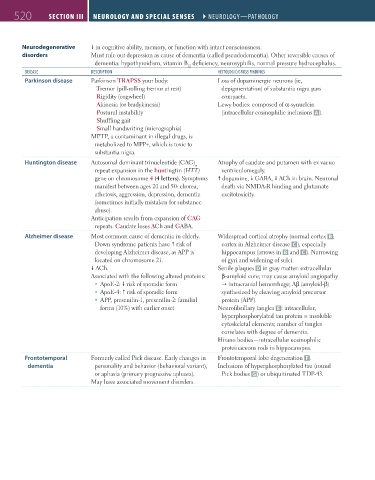
520 SecTioN iii Neurology aNd Special SeNSeS ` neurology—PAthology Neurology aNd Special SeNSeS ` neurology—PAthology
Neurodegenerative in cognitive ability, memory, or function with intact consciousness.
disorders Must rule out depression as cause of dementia (called pseudodementia). Other reversible causes of
dementia: hypothyroidism, vitamin B deficiency, neurosyphilis, normal pressure hydrocephalus.
12
diseAse desCriPtion histologiC/gross Findings
Parkinson disease Parkinson TRAPSS your body: Loss of dopaminergic neurons (ie,
Tremor (pill-rolling tremor at rest) depigmentation) of substantia nigra pars
Rigidity (cogwheel) compacta.
Akinesia (or bradykinesia) Lewy bodies: composed of α-synuclein
Postural instability (intracellular eosinophilic inclusions A ).
Shuffling gait
Small handwriting (micrographia)
MPTP, a contaminant in illegal drugs, is
metabolized to MPP+, which is toxic to
substantia nigra.
Huntington disease Autosomal dominant trinucleotide (CAG) Atrophy of caudate and putamen with ex vacuo
n
repeat expansion in the huntingtin (HTT) ventriculomegaly.
gene on chromosome 4 (4 letters). Symptoms dopamine, GABA, ACh in brain. Neuronal
manifest between ages 20 and 50: chorea, death via NMDA-R binding and glutamate
athetosis, aggression, depression, dementia excitotoxicity.
(sometimes initially mistaken for substance
abuse).
Anticipation results from expansion of CAG
repeats. Caudate loses ACh and GABA.
Alzheimer disease Most common cause of dementia in elderly. Widespread cortical atrophy (normal cortex B ;
Down syndrome patients have risk of cortex in Alzheimer disease C ), especially
developing Alzheimer disease, as APP is hippocampus (arrows in B and C ). Narrowing
located on chromosome 21. of gyri and widening of sulci.
ACh. Senile plaques D in gray matter: extracellular
Associated with the following altered proteins: β-amyloid core; may cause amyloid angiopathy
ApoE-2: risk of sporadic form intracranial hemorrhage; Aβ (amyloid-β)
ApoE-4: risk of sporadic form synthesized by cleaving amyloid precursor
APP, presenilin-1, presenilin-2: familial protein (APP).
forms (10%) with earlier onset Neurofibrillary tangles E : intracellular,
hyperphosphorylated tau protein = insoluble
cytoskeletal elements; number of tangles
correlates with degree of dementia.
Hirano bodies—intracellular eosinophilic
proteinaceous rods in hippocampus.
Frontotemporal Formerly called Pick disease. Early changes in Frontotemporal lobe degeneration F .
dementia personality and behavior (behavioral variant), Inclusions of hyperphosphorylated tau (round
or aphasia (primary progressive aphasia). Pick bodies G) or ubiquitinated TDP-43.
May have associated movement disorders.
FAS1_2019_12-Neurol.indd 520 11/8/19 7:39 AM

