


Page 559 - First Aid for the USMLE Step 1 2020, Thirtieth edition [MedicalBooksVN.com]_Neat
P. 559
Neurology aNd Special SeNSeS  ` neurology—PAthology  Neurology aNd Special SeNSeS  ` neurology—PAthology  SecTioN iii  515


                   Effects of strokes (continued)
                   Artery        AreA oF lesion                  symPtoms                       notes
                   Basilar artery Pons, medulla, lower midbrain.  If RAS spared, consciousness is   Locked-in syndrome (locked
                                                                   preserved.                    in the basement).
                                 Corticospinal and corticobulbar   Quadriplegia; loss of voluntary
                                  tracts.                          facial, mouth, and tongue
                                                                   movements.
                                 Ocular cranial nerve nuclei,    Loss of horizontal, but not vertical,
                                  paramedian pontine reticular     eye movements.
                                  formation.
                   Posterior     Occipital lobe  D.              Contralateral hemianopia with
                    cerebral                                       macular sparing; alexia without
                    artery                                         agraphia (dominant hemisphere).
                                 A                      B                     C                      D


                  Central poststroke     Neuropathic pain due to thalamic lesions. Initial paresthesias followed in weeks to months by
                  pain syndrome           allodynia (ordinarily painless stimuli cause pain) and dysesthesia (altered sensation) on the
                                          contralateral side. Occurs in 10% of stroke patients.


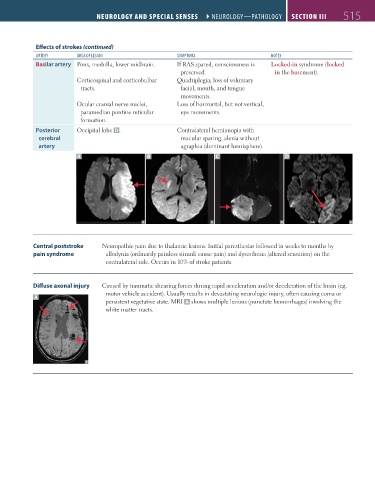
                  Diffuse axonal injury  Caused by traumatic shearing forces during rapid acceleration and/or deceleration of the brain (eg,
                                          motor vehicle accident). Usually results in devastating neurologic injury, often causing coma or
                   A
                                          persistent vegetative state. MRI  A  shows multiple lesions (punctate hemorrhages) involving the
                                          white matter tracts.


          FAS1_2019_12-Neurol.indd   515                                                                                11/8/19   7:39 AM

