


Page 560 - First Aid for the USMLE Step 1 2020, Thirtieth edition [MedicalBooksVN.com]_Neat
P. 560
516 SecTioN iii Neurology aNd Special SeNSeS ` neurology—PAthology Neurology aNd Special SeNSeS ` neurology—PAthology
Aphasia Aphasia—higher-order language deficit Good comprehension Poor comprehension
(inability to understand/produce/use language
appropriately); caused by pathology in dominant Wernicke
aphasia
Fluent
cerebral hemisphere (usually left). speech Conduction
aphasia
Dysarthria—motor inability to produce speech Transcortical
(movement deficit). sensory aphasia
Broca
Nonfluent aphasia Transcortical
speech mixed aphasia
Transcortical
motor aphasia
Poor repetition
Good repetition
tyPe Comments
Broca (expressive) Broca area in inferior frontal gyrus of frontal lobe. Patient appears frustrated, insight intact.
Broca = Broken Boca (boca = mouth in Spanish).
Wernicke (receptive) Wernicke area in superior temporal gyrus of temporal lobe. Patients do not have insight.
Wernicke is a Word salad and makes no sense.
Conduction Can be caused by damage to arCuate fasciculus.
Global Broca and Wernicke areas affected.
Transcortical motor Affects frontal lobe around Broca area, but Broca area is spared.
Transcortical sensory Affects temporal lobe around Wernicke area, but Wernicke area is spared.
Transcortical mixed Broca and Wernicke areas and arcuate fasciculus remain intact; surrounding watershed areas
affected.
Aneurysms Abnormal dilation of an artery due to weakening of vessel wall.
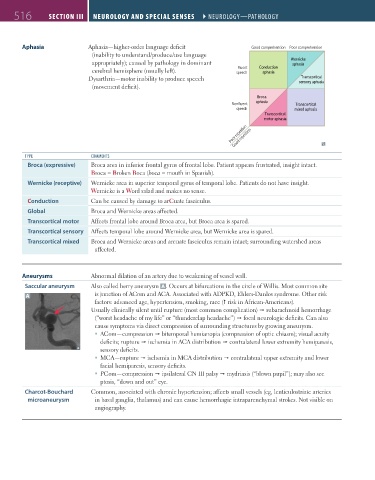
Saccular aneurysm Also called berry aneurysm A . Occurs at bifurcations in the circle of Willis. Most common site
A is junction of ACom and ACA. Associated with ADPKD, Ehlers-Danlos syndrome. Other risk
factors: advanced age, hypertension, smoking, race ( risk in African-Americans).
Usually clinically silent until rupture (most common complication) subarachnoid hemorrhage
(“worst headache of my life” or “thunderclap headache”) focal neurologic deficits. Can also
cause symptoms via direct compression of surrounding structures by growing aneurysm.
ACom—compression bitemporal hemianopia (compression of optic chiasm); visual acuity
deficits; rupture ischemia in ACA distribution contralateral lower extremity hemiparesis,
sensory deficits.
MCA—rupture ischemia in MCA distribution contralateral upper extremity and lower
facial hemiparesis, sensory deficits.
PCom—compression ipsilateral CN III palsy mydriasis (“blown pupil”); may also see
ptosis, “down and out” eye.
Charcot-Bouchard Common, associated with chronic hypertension; affects small vessels (eg, lenticulostriate arteries
microaneurysm in basal ganglia, thalamus) and can cause hemorrhagic intraparenchymal strokes. Not visible on
angiography.
FAS1_2019_12-Neurol.indd 516 11/8/19 7:39 AM

