


Page 568 - First Aid for the USMLE Step 1 2020, Thirtieth edition [MedicalBooksVN.com]_Neat
P. 568
524 SecTioN iii Neurology aNd Special SeNSeS ` neurology—PAthology Neurology aNd Special SeNSeS ` neurology—PAthology
Other demyelinating and dysmyelinating disorders
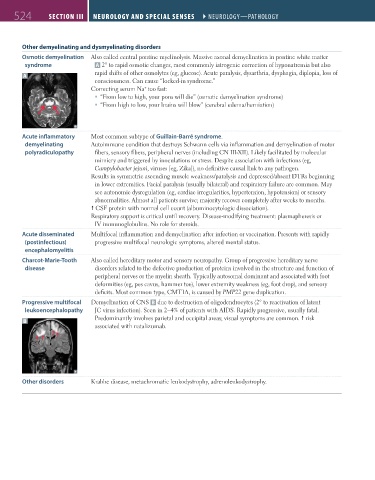
Osmotic demyelination Also called central pontine myelinolysis. Massive axonal demyelination in pontine white matter
syndrome A 2° to rapid osmotic changes, most commonly iatrogenic correction of hyponatremia but also
rapid shifts of other osmolytes (eg, glucose). Acute paralysis, dysarthria, dysphagia, diplopia, loss of
A
consciousness. Can cause “locked-in syndrome.”
Correcting serum Na too fast:
+
“From low to high, your pons will die” (osmotic demyelination syndrome)
“From high to low, your brains will blow” (cerebral edema/herniation)
Acute inflammatory Most common subtype of Guillain-Barré syndrome.
demyelinating Autoimmune condition that destroys Schwann cells via inflammation and demyelination of motor
polyradiculopathy fibers, sensory fibers, peripheral nerves (including CN III-XII). Likely facilitated by molecular
mimicry and triggered by inoculations or stress. Despite association with infections (eg,
Campylobacter jejuni, viruses [eg, Zika]), no definitive causal link to any pathogen.
Results in symmetric ascending muscle weakness/paralysis and depressed/absent DTRs beginning
in lower extremities. Facial paralysis (usually bilateral) and respiratory failure are common. May
see autonomic dysregulation (eg, cardiac irregularities, hypertension, hypotension) or sensory
abnormalities. Almost all patients survive; majority recover completely after weeks to months.
CSF protein with normal cell count (albuminocytologic dissociation).
Respiratory support is critical until recovery. Disease-modifying treatment: plasmapheresis or
IV immunoglobulins. No role for steroids.
Acute disseminated Multifocal inflammation and demyelination after infection or vaccination. Presents with rapidly
(postinfectious) progressive multifocal neurologic symptoms, altered mental status.
encephalomyelitis
Charcot-Marie-Tooth Also called hereditary motor and sensory neuropathy. Group of progressive hereditary nerve
disease disorders related to the defective production of proteins involved in the structure and function of
peripheral nerves or the myelin sheath. Typically autosomal dominant and associated with foot
deformities (eg, pes cavus, hammer toe), lower extremity weakness (eg, foot drop), and sensory
deficits. Most common type, CMT1A, is caused by PMP22 gene duplication.
Progressive multifocal Demyelination of CNS B due to destruction of oligodendrocytes (2° to reactivation of latent
leukoencephalopathy JC virus infection). Seen in 2–4% of patients with AIDS. Rapidly progressive, usually fatal.
Predominantly involves parietal and occipital areas; visual symptoms are common. risk
B
associated with natalizumab.
Other disorders Krabbe disease, metachromatic leukodystrophy, adrenoleukodystrophy.
FAS1_2019_12-Neurol.indd 524 11/8/19 7:39 AM

