


Page 587 - First Aid for the USMLE Step 1 2020, Thirtieth edition [MedicalBooksVN.com]_Neat
P. 587
Neurology aNd Special SeNSeS  ` neurology—oPhthAlmology  Neurology aNd Special SeNSeS  ` neurology—oPhthAlmology  SecTioN iii  543


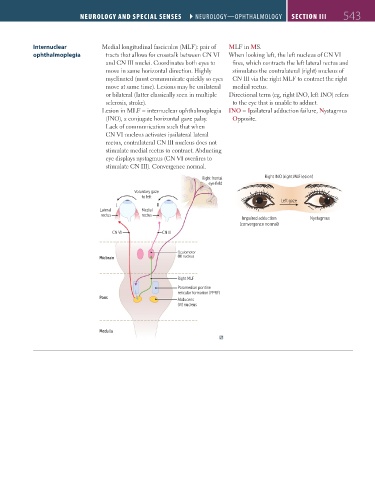
                  Internuclear           Medial longitudinal fasciculus (MLF): pair of   MLF in MS.
                  ophthalmoplegia         tracts that allows for crosstalk between CN VI   When looking left, the left nucleus of CN VI
                                          and CN III nuclei. Coordinates both eyes to   fires, which contracts the left lateral rectus and
                                          move in same horizontal direction. Highly   stimulates the contralateral (right) nucleus of
                                          myelinated (must communicate quickly so eyes   CN III via the right MLF to contract the right
                                          move at same time). Lesions may be unilateral   medial rectus.
                                          or bilateral (latter classically seen in multiple   Directional term (eg, right INO, left INO) refers
                                          sclerosis, stroke).                      to the eye that is unable to adduct.
                                         Lesion in MLF = internuclear ophthalmoplegia  INO = Ipsilateral adduction failure, Nystagmus
                                          (INO), a conjugate horizontal gaze palsy.   Opposite.
                                          Lack of communication such that when
                                          CN VI nucleus activates ipsilateral lateral
                                          rectus, contralateral CN III nucleus does not
                                          stimulate medial rectus to contract. Abducting
                                          eye displays nystagmus (CN VI overfires to
                                          stimulate CN III). Convergence normal.

                                                                          Right frontal       Right INO (right MLF lesion)
                                                                            eye field
                                                   Voluntary gaze
                                                      to left
                                                                                                   Left gaze
                                             L             R
                                        Lateral       Medial
                                         rectus       rectus
                                                                                       Impaired adduction    Nystagmus
                                                                                      (convergence normal)
                                            CN VI            CN III


                                                                  Oculomotor
                                        Midbrain                  (III) nucleus


                                                                  Right MLF
                                                                  Paramedian pontine
                                                                  reticular formation (PPRF)
                                        Pons
                                                                  Abducens
                                                                  (VI) nucleus


                                        Medulla


          FAS1_2019_12-Neurol.indd   543                                                                                11/8/19   7:39 AM

