


Page 585 - First Aid for the USMLE Step 1 2020, Thirtieth edition [MedicalBooksVN.com]_Neat
P. 585
Neurology aNd Special SeNSeS ` neurology—oPhthAlmology Neurology aNd Special SeNSeS ` neurology—oPhthAlmology SecTioN iii 541
CN III, IV, VI palsies
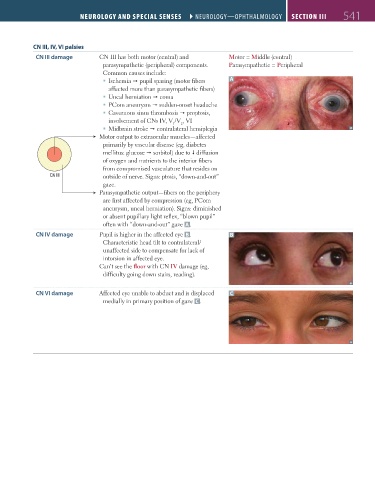
CN III damage CN III has both motor (central) and Motor = Middle (central)
parasympathetic (peripheral) components. Parasympathetic = Peripheral
Common causes include:
Ischemia pupil sparing (motor fibers A
affected more than parasympathetic fibers)
Uncal herniation coma
PCom aneurysm sudden-onset headache
Cavernous sinus thrombosis proptosis,
involvement of CNs IV, V /V , VI
1
2
Midbrain stroke contralateral hemiplegia
Motor output to extraocular muscles—affected
primarily by vascular disease (eg, diabetes
mellitus: glucose sorbitol) due to diffusion
of oxygen and nutrients to the interior fibers
from compromised vasculature that resides on
CN III outside of nerve. Signs: ptosis, “down-and-out”
gaze.
Parasympathetic output—fibers on the periphery
are first affected by compression (eg, PCom
aneurysm, uncal herniation). Signs: diminished
or absent pupillary light reflex, “blown pupil”
often with “down-and-out” gaze A .
CN IV damage Pupil is higher in the affected eye B . B
Characteristic head tilt to contralateral/
unaffected side to compensate for lack of
intorsion in affected eye.
Can’t see the floor with CN IV damage (eg,
difficulty going down stairs, reading).
CN VI damage Affected eye unable to abduct and is displaced C
medially in primary position of gaze C .
FAS1_2019_12-Neurol.indd 541 11/8/19 7:39 AM

