


Page 626 - First Aid for the USMLE Step 1 2020, Thirtieth edition [MedicalBooksVN.com]_Neat
P. 626
582        SeCTIOn III    Renal  ` RENAL—PhysioLogy                                                                                                                                 Renal  ` RENAL—PhysioLogy


               Renal clearance       C  = (U V)/P  = volume of plasma from which   C  = clearance of X (mL/min).
                                       x
                                                x
                                            x
                                                                                x
                                      the substance is completely cleared in the   U  = urine concentration of X (eg, mg/mL).
                                                                                x
                                      urine per unit time.                     P  = plasma concentration of X (eg, mg/mL).
                                                                                x
                                     If  C  < GFR: net tubular reabsorption and/or   V = urine flow rate (mL/min).
                                         x
                                      not freely filtered.
                                     If  C  > GFR: net tubular secretion of X.
                                         x
                                     If  C  = GFR: no net secretion or reabsorption.
                                         x
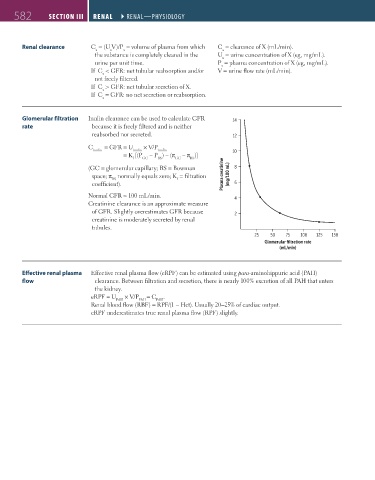
               Glomerular filtration   Inulin clearance can be used to calculate GFR   14
               rate                   because it is freely filtered and is neither
                                      reabsorbed nor secreted.                      12
                                    C      = GFR = U   × V/P
                                      inulin       inulin  inulin                  10
                                                = K  [(P  – P ) – (π  – π )]
                                                   f  GC   BS    GC   BS
                                    (GC = glomerular capillary; BS = Bowman         8
                                      space; π  normally equals zero; K  = filtration   Plasma creatinine  (mg/100 mL)
                                            BS                   f
                                      coefficient).                                 6
                                    Normal GFR ≈ 100 mL/min.                        4
                                    Creatinine clearance is an approximate measure
                                      of GFR. Slightly overestimates GFR because    2
                                      creatinine is moderately secreted by renal
                                      tubules.
                                                                                           25   50   75   100  125  150
                                                                                              Glomerular filtration rate
                                                                                                   (mL/min)


               Effective renal plasma   Effective renal plasma flow (eRPF) can be estimated using para-aminohippuric acid (PAH)
               flow                    clearance. Between filtration and secretion, there is nearly 100% excretion of all PAH that enters
                                       the kidney.
                                     eRPF = U PAH  × V/P PAH  = C PAH .
                                     Renal blood flow (RBF) = RPF/(1 − Hct). Usually 20–25% of cardiac output.
                                     eRPF underestimates true renal plasma flow (RPF) slightly.


          FAS1_2019_14-Renal.indd   582                                                                                 11/7/19   5:42 PM

