Page 84 - First Aid for the USMLE Step 1 2020, Thirtieth edition [MedicalBooksVN.com]_Neat
P. 84
40          SECTION II    BIOCHEmISTRY  ``BIOCHEMISTRY—MOlECUlAR                                                                                                     BIOCHEmISTRY  ``BIOCHEMISTRY—MOlECUlAR


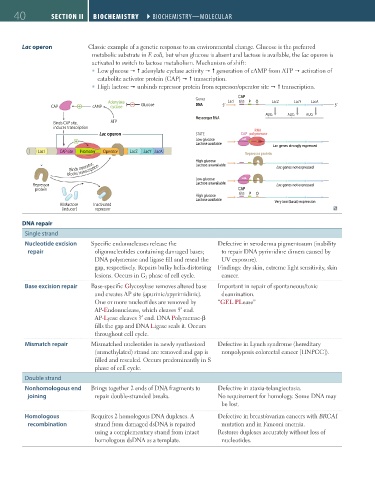
               Lac operon           Classic example of a genetic response to an environmental change. Glucose is the preferred
                                      metabolic substrate in E coli, but when glucose is absent and lactose is available, the lac operon is
                                      activated to switch to lactose metabolism. Mechanism of shift:
                                         ƒ Low glucose Ž  adenylate cyclase activity Ž  generation of cAMP from ATP Ž activation of
                                       catabolite activator protein (CAP) Ž  transcription.
                                         ƒ High lactose Ž unbinds repressor protein from repressor/operator site Ž  transcription.
                                                                                     CAP
                                                                       Genes
                                           Adenylate                              Lacl  site  P  O  LacZ  LacY  LacA
                        CAP           cAMP  cyclase   Glucose          DNA      5                                    3
                                                                                              AUG     AUG   AUG
                                                                       Messenger RNA
                         Binds CAP site,    ATP
                         induces transcription                                             RNA
                                        Lac operon                     STATE          CAP polymerase
                                                                       Low glucose
                                                                       Lactose available
                                                                                                 Lac genes strongly expressed
                    Lacl   CAP site  Promoter  Operator  LacZ  LacY LacA
                                                                                        Repressor protein
                                                                       High glucose
                                Binds operator,                        Lactose unavailable        Lac genes not expressed
                              blocks transcription
                                                                       Low glucose
                  Repressor                                            Lactose unavailable        Lac genes not expressed
                   protein                                                           CAP
                                                                       High glucose   site  P  O
                                                                       Lactose available         Very low (basal) expression
                           Allolactose   Inactivated
                            (inducer)  repressor
               DNA repair
                Single strand
                Nucleotide excision   Specific endonucleases release the       Defective in xeroderma pigmentosum (inability
                 repair                oligonucleotides containing damaged bases;   to repair DNA pyrimidine dimers caused by
                                       DNA polymerase and ligase fill and reseal the   UV exposure).
                                       gap, respectively. Repairs bulky helix-distorting  Findings: dry skin, extreme light sensitivity, skin
                                       lesions. Occurs in G 1  phase of cell cycle.  cancer.
                Base excision repair  Base-specific Glycosylase removes altered base   Important in repair of spontaneous/toxic
                                      and creates AP site (apurinic/apyrimidinic).   deamination.
                                      One or more nucleotides are removed by   “GEL PLease”
                                      AP-Endonuclease, which cleaves 5′ end.
                                      AP-Lyase cleaves 3′ end. DNA Polymerase-β
                                      fills the gap and DNA Ligase seals it. Occurs
                                      throughout cell cycle.

                Mismatch repair      Mismatched nucleotides in newly synthesized   Defective in Lynch syndrome (hereditary
                                      (unmethylated) strand are removed and gap is   nonpolyposis colorectal cancer [HNPCC]).
                                      filled and resealed. Occurs predominantly in S
                                      phase of cell cycle.
                Double strand
                Nonhomologous end    Brings together 2 ends of DNA fragments to   Defective in ataxia-telangiectasia.
                 joining              repair double-stranded breaks.           No requirement for homology. Some DNA may
                                                                                be lost.
                Homologous           Requires 2 homologous DNA duplexes. A     Defective in breast/ovarian cancers with BRCA1
                 recombination        strand from damaged dsDNA is repaired     mutation and in Fanconi anemia.
                                      using a complementary strand from intact   Restores duplexes accurately without loss of
                                      homologous dsDNA as a template.           nucleotides.


          FAS1_2019_01-Biochem.indd   40                                                                                11/7/19   3:16 PM
   79   80   81   82   83   84   85   86   87   88   89