


Page 166 - The City and Guilds Textbook: Plumbing Book 1 for the Level 3 Apprenticeship (9189), Level 2 Technical Certificate (8202) and Level 2 Diploma (6035)
P. 166
The City & Guilds Textbook: Plumbing Book 1
IMPROVE Compressive strength
YOUR MATHS Compressive strength is the maximum stress a material can sustain when
In the SI system, being crushed. Hard materials, such as concrete or cast iron, will shatter under
compressive strength is compressive stress, while others, like plastics and some metals, may distort in
measured using the unit shape. This is called barrelling.
newton per square metre
(N/m² or Pa – pascal). Compressive strength is calculated by dividing the maximum load by the
original cross-sectional area of a specimen in a compression test, and is
measured in units of force per unit area.
Shear strength
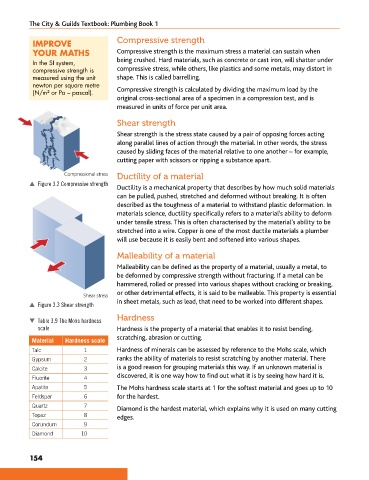
Shear strength is the stress state caused by a pair of opposing forces acting
along parallel lines of action through the material. In other words, the stress
caused by sliding faces of the material relative to one another – for example,
cutting paper with scissors or ripping a substance apart.
Compressional stress Ductility of a material
p Figure 3.2 Compressive strength
Ductility is a mechanical property that describes by how much solid materials
can be pulled, pushed, stretched and deformed without breaking. It is often
described as the toughness of a material to withstand plastic deformation. In
materials science, ductility specifically refers to a material’s ability to deform
under tensile stress. This is often characterised by the material’s ability to be
stretched into a wire. Copper is one of the most ductile materials a plumber
will use because it is easily bent and softened into various shapes.
Malleability of a material
Malleability can be defined as the property of a material, usually a metal, to
be deformed by compressive strength without fracturing. If a metal can be
hammered, rolled or pressed into various shapes without cracking or breaking,
or other detrimental effects, it is said to be malleable. This property is essential
Shear stress
in sheet metals, such as lead, that need to be worked into different shapes.
p Figure 3.3 Shear strength
Hardness
Table 3.9 The Mohs hardness
scale Hardness is the property of a material that enables it to resist bending,
Material Hardness scale scratching, abrasion or cutting.
Talc 1 Hardness of minerals can be assessed by reference to the Mohs scale, which
Gypsum 2 ranks the ability of materials to resist scratching by another material. There
Calcite 3 is a good reason for grouping materials this way. If an unknown material is
Fluorite 4 discovered, it is one way how to find out what it is by seeing how hard it is.
Apatite 5 The Mohs hardness scale starts at 1 for the softest material and goes up to 10
Feldspar 6 for the hardest.
Quartz 7
Diamond is the hardest material, which explains why it is used on many cutting
Topaz 8 edges.
Corundum 9
Diamond 10
154
9781510416482.indb 154 29/03/19 8:54 PM

