


Page 165 - The City and Guilds Textbook: Plumbing Book 1 for the Level 3 Apprenticeship (9189), Level 2 Technical Certificate (8202) and Level 2 Diploma (6035)
P. 165
Chapter 3 Scientific principles

                Ceramics and fireclays

                Ceramics and fireclays are used mainly for sanitary appliances and tiles. There
                are three varieties that plumbers may use widely in their work:
                1  Vitreous china: this is a clay material with an enamelled surface used to
                   manufacture bathroom appliances such as WCs and cisterns, wash hand
                   basins and bidets, as well as soap dishes and other sundry bathroom items. It
                   is made from very watery clay, known as ‘slip’, which is then spray enamelled
                   and fired in a kiln at high temperature.
                2  Fireclay: this is used primarily for heavy-duty appliances, such as Belfast
                   sinks, London sinks, cleaners’ and butler’s sinks and shower trays, where
                   there is greater risk of damage and a higher water temperature may be
                   needed. Like other clays, this clay is highly malleable in its raw form. It can be
                   moulded, extruded and shaped by hand. It is also used in the manufacture of
                   building products such as chimney pots.
                3  Ceramic tiles: these have many applications and are used extensively in
                   bathrooms, kitchens, floors and swimming pools. The origin of the tile can
                   be identified from looking at the reverse of the tile. This is known as the
                   ‘biscuit’ of the tile. Tiles made in the UK usually have a white-coloured
                   biscuit, Italian tiles usually have biscuit that is cream in colour, and Turkish
                   and Spanish tiles have a dark red biscuit.

                Principal properties of solid materials

                Solid materials are made up of many molecules. How these molecules are
                arranged and how they behave under certain conditions will determine their
                properties. A solid material is assessed by its:

                ●  strength – tensile, compressive and shear
                ●  ductility
                ●  malleability
                ●  hardness
                ●  conductivity – heat and electricity.

                Tensile strength

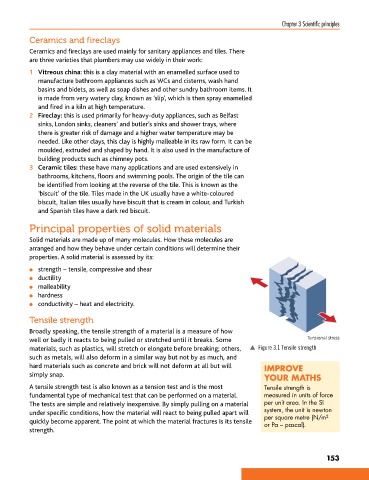
                Broadly speaking, the tensile strength of a material is a measure of how
                well or badly it reacts to being pulled or stretched until it breaks. Some                Tensional stress
                materials, such as plastics, will stretch or elongate before breaking; others,   p  Figure 3.1 Tensile strength
                such as metals, will also deform in a similar way but not by as much, and
                hard materials such as concrete and brick will not deform at all but will   IMPROVE
                simply snap.                                                                YOUR MATHS

                A tensile strength test is also known as a tension test and is the most     Tensile strength is
                fundamental type of mechanical test that can be performed on a material.    measured in units of force
                The tests are simple and relatively inexpensive. By simply pulling on a material   per unit area. In the SI
                under specific conditions, how the material will react to being pulled apart will   system, the unit is newton
                quickly become apparent. The point at which the material fractures is its tensile   per square metre (N/m²
                                                                                            or Pa – pascal).
                strength.


                                                                                                                153


        9781510416482.indb   153                                                                                    29/03/19   8:54 PM

