


Page 169 - The City and Guilds Textbook: Plumbing Book 1 for the Level 3 Apprenticeship (9189), Level 2 Technical Certificate (8202) and Level 2 Diploma (6035)
P. 169
Chapter 3 Scientific principles


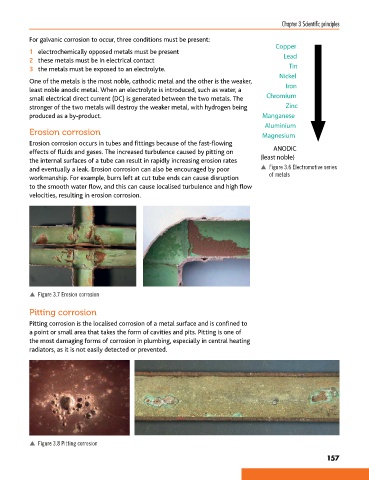
                For galvanic corrosion to occur, three conditions must be present:
                                                                                                Copper
                1  electrochemically opposed metals must be present                               Lead
                2  these metals must be in electrical contact
                3  the metals must be exposed to an electrolyte.                                    Tin
                                                                                                 Nickel
                One of the metals is the most noble, cathodic metal and the other is the weaker,   Iron
                least noble anodic metal. When an electrolyte is introduced, such as water, a
                small electrical direct current (DC) is generated between the two metals. The   Chromium
                stronger of the two metals will destroy the weaker metal, with hydrogen being      Zinc
                produced as a by-product.                                                  Manganese
                                                                                            Aluminium
                Erosion corrosion                                                          Magnesium

                Erosion corrosion occurs in tubes and fittings because of the fast-flowing
                effects of fluids and gases. The increased turbulence caused by pitting on     ANODIC
                the internal surfaces of a tube can result in rapidly increasing erosion rates   (least noble)
                and eventually a leak. Erosion corrosion can also be encouraged by poor    p  Figure 3.6 Electromotive series
                workmanship. For example, burrs left at cut tube ends can cause disruption    of metals
                to the smooth water flow, and this can cause localised turbulence and high flow
                velocities, resulting in erosion corrosion.


                p  Figure 3.7 Erosion corrosion


                Pitting corrosion
                Pitting corrosion is the localised corrosion of a metal surface and is confined to
                a point or small area that takes the form of cavities and pits. Pitting is one of
                the most damaging forms of corrosion in plumbing, especially in central heating
                radiators, as it is not easily detected or prevented.


                p  Figure 3.8 Pitting corrosion

                                                                                                                157


        9781510416482.indb   157                                                                                    29/03/19   8:55 PM

