


Page 163 - The City and Guilds Textbook: Plumbing Book 1 for the Level 3 Apprenticeship (9189), Level 2 Technical Certificate (8202) and Level 2 Diploma (6035)
P. 163
Chapter 3 Scientific principles
Metals can be subdivided into four specific groups, as described below.
1 Pure metals: these are the metals that are derived directly from the ore and
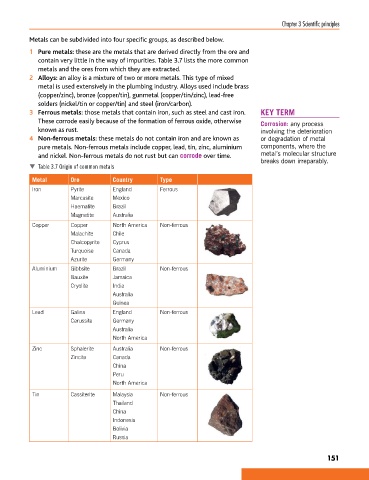
contain very little in the way of impurities. Table 3.7 lists the more common
metals and the ores from which they are extracted.
2 Alloys: an alloy is a mixture of two or more metals. This type of mixed
metal is used extensively in the plumbing industry. Alloys used include brass
(copper/zinc), bronze (copper/tin), gunmetal (copper/tin/zinc), lead-free
solders (nickel/tin or copper/tin) and steel (iron/carbon).
3 Ferrous metals: those metals that contain iron, such as steel and cast iron. KEY TERM
These corrode easily because of the formation of ferrous oxide, otherwise Corrosion: any process
known as rust. involving the deterioration
4 Non-ferrous metals: these metals do not contain iron and are known as or degradation of metal
pure metals. Non-ferrous metals include copper, lead, tin, zinc, aluminium components, where the
and nickel. Non-ferrous metals do not rust but can corrode over time. metal’s molecular structure
breaks down irreparably.
Table 3.7 Origin of common metals
Metal Ore Country Type
Iron Pyrite England Ferrous
Marcasite Mexico
Haematite Brazil
Magnetite Australia
Copper Copper North America Non-ferrous
Malachite Chile
Chalcopyrite Cyprus
Turquoise Canada
Azurite Germany
Aluminium Gibbsite Brazil Non-ferrous
Bauxite Jamaica
Cryolite India
Australia
Guinea
Lead Galina England Non-ferrous
Cerussite Germany
Australia
North America
Zinc Sphalerite Australia Non-ferrous
Zincite Canada
China
Peru
North America
Tin Cassiterite Malaysia Non-ferrous
Thailand
China
Indonesia
Bolivia
Russia
151
9781510416482.indb 151 29/03/19 8:54 PM

