


Page 168 - The City and Guilds Textbook: Plumbing Book 1 for the Level 3 Apprenticeship (9189), Level 2 Technical Certificate (8202) and Level 2 Diploma (6035)
P. 168
The City & Guilds Textbook: Plumbing Book 1


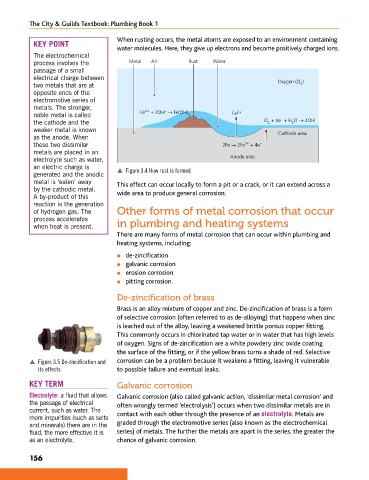
                                            When rusting occurs, the metal atoms are exposed to an environment containing
                 KEY POINT
                                            water molecules. Here, they give up electrons and become positively charged ions.
                 The electrochemical
                 process involves the           Metal  Air         Rust    Water
                 passage of a small
                 electrical charge between
                 two metals that are at                                                         Oxygen (O 2 )
                 opposite ends of the
                 electromotive series of
                 metals. The stronger,               2+     −
                 noble metal is called              Fe   + 2OH → Fe(OH) 2         Fe 2+
                                                                                                 −
                 the cathode and the                                                        O + 4e  + H O → 4OH −
                                                                                             2
                                                                                                     2
                 weaker metal is known
                 as the anode. When                                                             Cathode area
                 these two dissimilar                                         2Fe → 2Fe  + 4e −
                                                                                      2+
                 metals are placed in an
                 electrolyte such as water,                                      Anode area
                 an electric charge is      p  Figure 3.4 How rust is formed
                 generated and the anodic
                 metal is ‘eaten’ away      This effect can occur locally to form a pit or a crack, or it can extend across a
                 by the cathodic metal.     wide area to produce general corrosion.
                 A by-product of this
                 reaction is the generation
                 of hydrogen gas. The       Other forms of metal corrosion that occur
                 process accelerates
                 when heat is present.      in plumbing and heating systems
                                            There are many forms of metal corrosion that can occur within plumbing and
                                            heating systems, including:
                                            ●  de-zincification
                                            l  galvanic corrosion
                                            l  erosion corrosion
                                            l  pitting corrosion.
                                            De-zincification of brass

                                            Brass is an alloy mixture of copper and zinc. De-zincification of brass is a form
                                            of selective corrosion (often referred to as de-alloying) that happens when zinc
                                            is leached out of the alloy, leaving a weakened brittle porous copper fitting.
                                            This commonly occurs in chlorinated tap water or in water that has high levels
                                            of oxygen. Signs of de-zincification are a white powdery zinc oxide coating
                                            the surface of the fitting, or if the yellow brass turns a shade of red. Selective
                p  Figure 3.5 De-zincification and   corrosion can be a problem because it weakens a fitting, leaving it vulnerable
                   its effects              to possible failure and eventual leaks.

                KEY TERM                    Galvanic corrosion
                Electrolyte: a fluid that allows   Galvanic corrosion (also called galvanic action, ‘dissimilar metal corrosion’ and
                the passage of electrical   often wrongly termed ‘electrolysis’) occurs when two dissimilar metals are in
                current, such as water. The   contact with each other through the presence of an electrolyte. Metals are
                more impurities (such as salts
                and minerals) there are in the   graded through the electromotive series (also known as the electrochemical
                fluid, the more effective it is   series) of metals. The further the metals are apart in the series, the greater the
                as an electrolyte.          chance of galvanic corrosion.


                156


        9781510416482.indb   156                                                                                    29/03/19   8:55 PM

