


Page 173 - The City and Guilds Textbook: Plumbing Book 1 for the Level 3 Apprenticeship (9189), Level 2 Technical Certificate (8202) and Level 2 Diploma (6035)
P. 173
Chapter 3 Scientific principles
Table 3.11 Classification of water
Type of water pH value Base Notes
Neutral 7 N/A Neutral water is neither soft nor hard.
Soft Below 7 Acidic Water is made soft by the presence of carbon dioxide (CO 2 ). It is particularly destructive
to plumbing systems containing lead as it can dissolve the lead, making the water
contaminated. Because of its lead-dissolving capability, soft water is known as ‘plumbo-
solvent’. Soft water lathers soap easily.
Temporary Above 7 Alkali Temporary hard water contains calcium carbonate (CaCO 3 ), otherwise known as limestone.
hard water This kind of water can be softened by boiling but leaves behind limescale residues, which
can block pipes and other plumbing fittings and appliances. When water reaches 65°C, the
calcium in the water re-forms in a process known as precipitation, causing scaling within
plumbing systems. Lathering of soap is difficult.
Permanently Above 7 Alkali Permanently hard water contains magnesium and calcium chlorides, and sulphates in the
hard water solution. It cannot be softened by boiling.
Capillary attraction
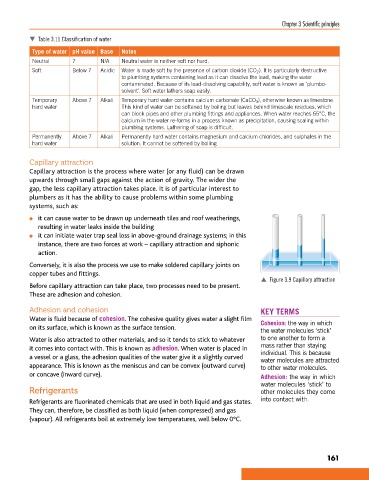
Capillary attraction is the process where water (or any fluid) can be drawn
upwards through small gaps against the action of gravity. The wider the
gap, the less capillary attraction takes place. It is of particular interest to
plumbers as it has the ability to cause problems within some plumbing
systems, such as:
l it can cause water to be drawn up underneath tiles and roof weatherings,
resulting in water leaks inside the building
l it can initiate water trap seal loss in above-ground drainage systems; in this
instance, there are two forces at work – capillary attraction and siphonic
action.
Conversely, it is also the process we use to make soldered capillary joints on
copper tubes and fittings.
p Figure 3.9 Capillary attraction
Before capillary attraction can take place, two processes need to be present.
These are adhesion and cohesion.
Adhesion and cohesion KEY TERMS
Water is fluid because of cohesion. The cohesive quality gives water a slight film Cohesion: the way in which
on its surface, which is known as the surface tension. the water molecules ‘stick’
Water is also attracted to other materials, and so it tends to stick to whatever to one another to form a
it comes into contact with. This is known as adhesion. When water is placed in mass rather than staying
individual. This is because
a vessel or a glass, the adhesion qualities of the water give it a slightly curved water molecules are attracted
appearance. This is known as the meniscus and can be convex (outward curve) to other water molecules.
or concave (inward curve). Adhesion: the way in which
water molecules ‘stick’ to
Refrigerants other molecules they come
Refrigerants are fluorinated chemicals that are used in both liquid and gas states. into contact with.
They can, therefore, be classified as both liquid (when compressed) and gas
(vapour). All refrigerants boil at extremely low temperatures, well below 0°C.
161
9781510416482.indb 161 29/03/19 8:55 PM

