


Page 178 - The City and Guilds Textbook: Plumbing Book 1 for the Level 3 Apprenticeship (9189), Level 2 Technical Certificate (8202) and Level 2 Diploma (6035)
P. 178
The City & Guilds Textbook: Plumbing Book 1

                                            3 THE RELATIONSHIP BETWEEN

                                            ENERGY, HEAT AND POWER


                                            The relationship between energy, heat and power is such that it is almost
                                            impossible to have one without the other two. Below is a list of units for
                                            energy, heat and power.

                                            l  The unit of power: the watt is the SI unit for power. It is equivalent to one
                                               joule per second (1 J/s) or, in electrical units, one volt ampere (1 V·A).
                                            l  The unit of heat: the joule is the unit of heat; 4.186 joule of heat energy
                                               (which equals one calorie) is required to raise the temperature of 1 g of water
                                               from 0°C to 1°C.
                                            l  The unit of energy: also the joule (see above).
                                            l  Specific heat capacity: the specific heat capacity of a substance is the
                                               amount of heat required to change a unit mass of that substance by one
                                               degree in temperature. It is measured in kilojoules per kilogram per degree
                                               celsius (kJ/kg/°C).

                                            Heat energy is transferred because of temperature difference – for example,
                                            heat passes from a warm body with high temperature to a cold body with low
                                            temperature. The transfer of energy as a result of the temperature difference
                                            alone is referred to as heat flow. The watt, which is the SI unit of power, can be
                                            defined as 1 joule per second (J/s) of heat flow.
                                            In this part of the chapter, we will investigate the energy/heat/power/temperature
                           DEGREES
                                            relationship, and its implications for the building services industry.
                       Celsius      Kelvin        Farenheit
                    100     373     212
                                            Temperature

                                            Temperature is simply the degree of hotness or coldness of a body or environment,
                                            and is expressed in terms of units or degrees designated on a standard scale,
                    0       273     32
                                            usually celsius (centigrade) (°C) or kelvin (K).
                                            Celsius (°C)

                                            This scale, using increments of 1 degree (1°), is the most widely used by the
                    - 100   173     - 148
                                            building services industry. In simple terms, it has a zero point (0°C), which
                                            corresponds to the temperature at which water will freeze. When this scale is
                                            used, the degree symbol (°) should accompany it, i.e. 21°C.

                    - 200   73      - 328
                                            Kelvin (K)
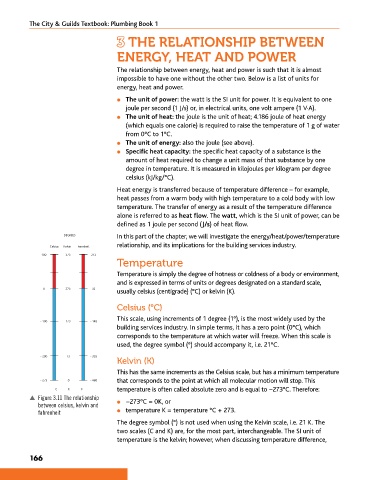
                                            This has the same increments as the Celsius scale, but has a minimum temperature
                    - 273   0       - 460   that corresponds to the point at which all molecular motion will stop. This
                                            temperature is often called absolute zero and is equal to −273°C. Therefore:
                        C     K          F
                p  Figure 3.11 The relationship   l  −273°C = 0K, or
                   between celsius, kelvin and
                   fahrenheit               l  temperature K = temperature °C + 273.
                                            The degree symbol (°) is not used when using the Kelvin scale, i.e. 21 K. The
                                            two scales (C and K) are, for the most part, interchangeable. The SI unit of
                                            temperature is the kelvin; however, when discussing temperature difference,


                166


        9781510416482.indb   166                                                                                    29/03/19   8:55 PM

