


Page 174 - The City and Guilds Textbook: Plumbing Book 1 for the Level 3 Apprenticeship (9189), Level 2 Technical Certificate (8202) and Level 2 Diploma (6035)
P. 174
The City & Guilds Textbook: Plumbing Book 1

                                            When a refrigerant gas is compressed, it changes its state to a liquid. During this
                                            process a lot of heat and pressure are generated. When the pressure is released
                                            quickly, it generates cold. Refrigerants’ ability to change their state quickly with
                                            such wide temperature changes allows them to be used in refrigeration plants,
                                            air conditioning systems and heat pumps. The process is known as the vapour
                                            compression refrigeration cycle.


                                                            Vapour             Vapour
                                                                    Compressor


                                            Evaporator           Fan                         Condenser


                                                        Liquid & vapour        Liquid
                                                                  Expansion valve
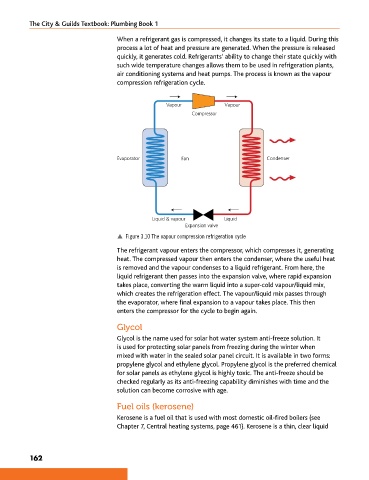
                                            p  Figure 3.10 The vapour compression refrigeration cycle

                                            The refrigerant vapour enters the compressor, which compresses it, generating
                                            heat. The compressed vapour then enters the condenser, where the useful heat
                                            is removed and the vapour condenses to a liquid refrigerant. From here, the
                                            liquid refrigerant then passes into the expansion valve, where rapid expansion
                                            takes place, converting the warm liquid into a super-cold vapour/liquid mix,
                                            which creates the refrigeration effect. The vapour/liquid mix passes through
                                            the evaporator, where final expansion to a vapour takes place. This then
                                            enters the compressor for the cycle to begin again.

                                            Glycol

                                            Glycol is the name used for solar hot water system anti-freeze solution. It
                                            is used for protecting solar panels from freezing during the winter when
                                            mixed with water in the sealed solar panel circuit. It is available in two forms:
                                            propylene glycol and ethylene glycol. Propylene glycol is the preferred chemical
                                            for solar panels as ethylene glycol is highly toxic. The anti-freeze should be
                                            checked regularly as its anti-freezing capability diminishes with time and the
                                            solution can become corrosive with age.
                                            Fuel oils (kerosene)

                                            Kerosene is a fuel oil that is used with most domestic oil-fired boilers (see
                                            Chapter 7, Central heating systems, page 461). Kerosene is a thin, clear liquid


                162


        9781510416482.indb   162                                                                                    29/03/19   8:55 PM

